Antibody–drug conjugate
-
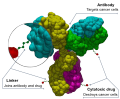 Structure of an antibody-drug conjugate

Antibody–drug conjugate[edit]
An antibody–drug conjugate (ADC) is a targeted cancer therapy that combines an antibody with a biologically active cytotoxic drug. The purpose of ADCs is to deliver the cytotoxic drug specifically to cancer cells, thereby minimizing systemic exposure and reducing side effects.
Structure and Mechanism[edit]
ADCs are composed of three main components:
- The antibody: A monoclonal antibody that specifically binds to an antigen expressed on the surface of cancer cells.
- The cytotoxic drug: A potent anti-cancer agent that is too toxic to be administered on its own.
- The linker: A chemical bridge that connects the antibody to the drug and is stable in the bloodstream but releases the drug once inside the target cell.
The mechanism of action involves the binding of the ADC to the target antigen on the cancer cell surface. Upon binding, the ADC is internalized into the cell, where the linker is cleaved, releasing the cytotoxic drug. The drug then exerts its effect, typically by disrupting critical cellular processes such as DNA replication or microtubule function, leading to cell death.
Development and Challenges[edit]
The development of ADCs involves several challenges, including:
- Selection of the appropriate target antigen that is highly expressed on cancer cells but not on normal cells.
- Designing a stable linker that can withstand systemic circulation but release the drug efficiently inside the target cell.
- Ensuring the cytotoxic drug is potent enough to kill cancer cells at low concentrations.
Despite these challenges, several ADCs have been approved for clinical use, and many more are in various stages of development.
Clinical Applications[edit]
ADCs have been approved for the treatment of various types of cancer, including:
Each ADC is designed to target specific cancer types based on the expression of the target antigen.
Future Directions[edit]
Research in ADCs is focused on improving their efficacy and safety. This includes:
- Developing new linkers that are more stable and release the drug more efficiently.
- Identifying new target antigens for different types of cancer.
- Combining ADCs with other forms of cancer therapy, such as immunotherapy or chemotherapy.
Related pages[edit]
 | This medical treatment–related article is a stub. You can help WikiMD by expanding the page. |

Medical Disclaimer: WikiMD is for informational purposes only and is not a substitute for professional medical advice. Content may be inaccurate or outdated and should not be used for diagnosis or treatment. Always consult your healthcare provider for medical decisions. Verify information with trusted sources such as CDC.gov and NIH.gov. By using this site, you agree that WikiMD is not liable for any outcomes related to its content. See full disclaimer.
Credits:Most images are courtesy of Wikimedia commons, and templates, categories Wikipedia, licensed under CC BY SA or similar.
Translate page: - East Asian
中文,
日本,
한국어,
South Asian
हिन्दी,
தமிழ்,
తెలుగు,
Urdu,
ಕನ್ನಡ,
Southeast Asian
Indonesian,
Vietnamese,
Thai,
မြန်မာဘာသာ,
বাংলা
European
español,
Deutsch,
français,
Greek,
português do Brasil,
polski,
română,
русский,
Nederlands,
norsk,
svenska,
suomi,
Italian
Middle Eastern & African
عربى,
Turkish,
Persian,
Hebrew,
Afrikaans,
isiZulu,
Kiswahili,
Other
Bulgarian,
Hungarian,
Czech,
Swedish,
മലയാളം,
मराठी,
ਪੰਜਾਬੀ,
ગુજરાતી,
Portuguese,
Ukrainian

