Humanitarian daily ration
Humanitarian Daily Ration (HDR) is a self-contained, individually packaged meal designed to be given to civilians and military personnel in disaster or emergency situations where local food supplies are not available. The HDR is intended to provide a full day's sustenance to an adult individual, and it is distinguished by its high caloric content, balanced nutrition, and ease of distribution. The concept behind the HDR aligns with broader humanitarian aid and disaster relief efforts, aiming to address immediate nutritional needs in crises while longer-term solutions are developed.
Overview[edit]
The HDR typically includes a variety of food items that require no refrigeration and can be consumed without cooking or preparation. Each ration pack is designed to provide approximately 2,200 to 2,400 calories, aligning with the daily energy requirements of an adult. The contents of an HDR are selected to be culturally neutral, minimizing the risk of dietary restrictions or preferences affecting the utility of the aid. Common components include entrees, snacks, a dessert, bread or crackers, spreads, and beverages. The packaging is designed to be durable, easy to distribute, and, in some cases, airtight and waterproof.
History[edit]
The concept of the HDR was developed in the early 1990s by the United States Department of Defense, specifically by the Defense Logistics Agency, in response to the need for an easily distributable food solution for humanitarian crises. The first significant deployment of HDRs was in the aftermath of natural disasters and during military operations that resulted in large displaced populations, such as in the Balkans during the 1990s.
Components and Nutrition[edit]
Each HDR is formulated to provide a balanced diet, including carbohydrates, proteins, fats, vitamins, and minerals. The selection of food items is based on nutritional needs, shelf life, and the goal of providing a palatable meal under adverse conditions. The ration typically avoids items that are known allergens or that have religious dietary restrictions, such as pork or alcohol.
Distribution[edit]
HDRs are distributed by military forces, non-governmental organizations (NGOs), and international organizations involved in humanitarian aid, such as the United Nations World Food Programme. The distribution process is coordinated with local authorities and aid organizations to ensure that the rations reach those in most need and to avoid interfering with local food markets and economies.
Ethical and Practical Considerations[edit]
While HDRs are an essential tool in immediate disaster response, they are not intended as a long-term solution to food insecurity. Ethical considerations include the importance of transitioning from emergency food aid to support for local food production and distribution systems. Additionally, the environmental impact of packaging and the logistics of distribution are ongoing concerns within the humanitarian community.
See Also[edit]

-
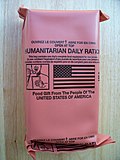 Humanitarian Daily Ration


Medical Disclaimer: WikiMD is for informational purposes only and is not a substitute for professional medical advice. Content may be inaccurate or outdated and should not be used for diagnosis or treatment. Always consult your healthcare provider for medical decisions. Verify information with trusted sources such as CDC.gov and NIH.gov. By using this site, you agree that WikiMD is not liable for any outcomes related to its content. See full disclaimer.
Credits:Most images are courtesy of Wikimedia commons, and templates, categories Wikipedia, licensed under CC BY SA or similar.
Translate page: - East Asian
中文,
日本,
한국어,
South Asian
हिन्दी,
தமிழ்,
తెలుగు,
Urdu,
ಕನ್ನಡ,
Southeast Asian
Indonesian,
Vietnamese,
Thai,
မြန်မာဘာသာ,
বাংলা
European
español,
Deutsch,
français,
Greek,
português do Brasil,
polski,
română,
русский,
Nederlands,
norsk,
svenska,
suomi,
Italian
Middle Eastern & African
عربى,
Turkish,
Persian,
Hebrew,
Afrikaans,
isiZulu,
Kiswahili,
Other
Bulgarian,
Hungarian,
Czech,
Swedish,
മലയാളം,
मराठी,
ਪੰਜਾਬੀ,
ગુજરાતી,
Portuguese,
Ukrainian

