Amblyomma
-
 Amblyomma
 -
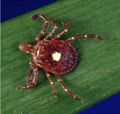 Amblyomma americanum tick
 -
 Amblyomma cajennense
 -
 Amblyomma maculatum
 -
 Amblyomma marmoreum
 -
 Amblyomma scalpturatum
 -
 Amblyomma supinoi
 -
 Amblyomma triste
 -
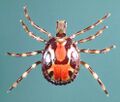 Amblyomma variegatum male


_-_Mites_-_Collection_Anthonie_Cornelis_Oudemans.jpeg)


Amblyomma[edit]
Amblyomma is a genus of hard ticks belonging to the family Ixodidae. This genus is known for its wide distribution and the role it plays as a vector for various pathogens affecting both humans and animals. Members of this genus are characterized by their ornate scutum and long mouthparts.
Description[edit]
Ticks of the genus Amblyomma are relatively large compared to other tick genera. They possess a hard scutum that often displays distinctive patterns or coloration. The mouthparts, or capitulum, are long and adapted for deep penetration into the host's skin, which facilitates feeding on blood.
Distribution[edit]
Amblyomma species are found worldwide, with a significant presence in tropical and subtropical regions. They are particularly prevalent in the Americas, Africa, and parts of Asia. The distribution of each species within the genus can vary significantly, with some species having a very localized range while others are more widespread.
Life Cycle[edit]
The life cycle of Amblyomma ticks includes four stages: egg, larva, nymph, and adult. After hatching from eggs, larvae seek out a host to feed on before molting into nymphs. Nymphs also require a blood meal before they can molt into adults. Adult ticks feed on larger hosts, including mammals, birds, and reptiles. The entire life cycle can take several months to years, depending on environmental conditions and host availability.
Medical and Veterinary Importance[edit]
Amblyomma ticks are of significant medical and veterinary importance due to their role as vectors of various pathogens. They are known to transmit Rickettsia, Ehrlichia, and Coxiella species, which can cause diseases such as Rocky Mountain spotted fever, ehrlichiosis, and Q fever. In livestock, they can transmit pathogens that lead to economic losses due to decreased productivity and increased veterinary costs.
Species[edit]
There are numerous species within the Amblyomma genus, some of which include:
- Amblyomma americanum - commonly known as the lone star tick, found primarily in the southeastern United States.
- Amblyomma cajennense - known as the cayenne tick, found in Central and South America.
- Amblyomma variegatum - known as the tropical bont tick, found in Africa and the Caribbean.
Control and Prevention[edit]
Controlling Amblyomma tick populations involves integrated pest management strategies, including habitat modification, use of acaricides, and biological control methods. Personal protective measures, such as wearing protective clothing and using tick repellents, are recommended to prevent tick bites in endemic areas.
Related pages[edit]

Sponsored Health Resource

W8MD Weight Loss, Sleep & MedSpa
Looking for physician-supervised weight loss, semaglutide, tirzepatide, or GLP-1 receptor agonist options? W8MD helps eligible patients in New York City, Brooklyn, New Jersey, Connecticut, Pennsylvania, Delaware, and greater Philadelphia with medical weight loss, sleep medicine, and long-term maintenance support.
GLP-1 specials: Affordable GLP-1 injections NYC and Philadelphia starting from $29.99/week and up for semaglutide with insurance accepted for qualifying visits, and $45/week and up for tirzepatide with insurance accepted for qualifying visits. Self-pay options start from $59.99/week and up for semaglutide and $69.99/week and up for tirzepatide.
Medical weight loss NYC | Affordable GLP-1 injections NYC | Budget GLP-1 weight loss shots Philadelphia | New Jersey medical weight loss | NYC medical weight loss | Philadelphia medical weight loss | Sleep clinic NYC | W8MD's Philadelphia GLP-1 doctor | Weight loss prescriptions NYC
Book a W8MD appointment · View GLP-1 specials
Paid promotional message. Eligibility, pricing, insurance coverage, medication availability, and results vary. Medical evaluation required.

Medical Disclaimer: WikiMD is for informational purposes only and is not a substitute for professional medical advice. Content may be inaccurate or outdated and should not be used for diagnosis or treatment. Always consult your healthcare provider for medical decisions. Verify information with trusted sources such as CDC.gov and NIH.gov. By using this site, you agree that WikiMD is not liable for any outcomes related to its content. See full disclaimer.
Credits:Most images are courtesy of Wikimedia commons, and templates, categories Wikipedia, licensed under CC BY SA or similar.
Translate page: - East Asian
中文,
日本,
한국어,
South Asian
हिन्दी,
தமிழ்,
తెలుగు,
Urdu,
ಕನ್ನಡ,
Southeast Asian
Indonesian,
Vietnamese,
Thai,
မြန်မာဘာသာ,
বাংলা
European
español,
Deutsch,
français,
Greek,
português do Brasil,
polski,
română,
русский,
Nederlands,
norsk,
svenska,
suomi,
Italian
Middle Eastern & African
عربى,
Turkish,
Persian,
Hebrew,
Afrikaans,
isiZulu,
Kiswahili,
Other
Bulgarian,
Hungarian,
Czech,
Swedish,
മലയാളം,
मराठी,
ਪੰਜਾਬੀ,
ગુજરાતી,
Portuguese,
Ukrainian

