Aleurites moluccanus
-
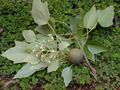 Aleurites moluccanus
 -
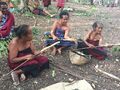 Candle nut sticks
 -
 Aleurites moluccanus flower
 -
 The young leaves of Aleurites moluccanus
 -
 Aleurites moluccanus at Inspiration Lake, Hong Kong
 -
 Candle nuts (kemiri)
 -
 Aleurites moluccanus
 -
 Aleurites moluccanus


.jpg)
.jpg)


Aleurites moluccanus[edit]
Aleurites moluccanus, commonly known as the candlenut tree, is a species of flowering tree in the spurge family (Euphorbiaceae). It is native to the Indo-Malaysian region and has been widely cultivated in other tropical areas. The tree is notable for its seeds, which are rich in oil and have various traditional and industrial uses.
Description[edit]
Aleurites moluccanus is a medium-sized tree that can grow up to 15–25 meters in height. The tree has a spreading crown and a straight trunk. The leaves are simple, alternate, and can be ovate or lobed, measuring 10–20 cm in length. The upper surface of the leaves is dark green, while the underside is covered with fine hairs, giving it a silvery appearance.
The tree produces small, white, fragrant flowers that are arranged in terminal panicles. The fruit is a spherical drupe, about 4–6 cm in diameter, with a hard shell. Inside the fruit are one or two large seeds, which are the source of the valuable oil.
Distribution and Habitat[edit]
Aleurites moluccanus is native to Southeast Asia, including the Philippines, Indonesia, and Malaysia. It has been introduced to other tropical regions, such as Hawaii, India, and parts of Africa. The tree thrives in a variety of habitats, from coastal areas to upland forests, and is often found in disturbed sites and secondary forests.
Uses[edit]
The seeds of Aleurites moluccanus are rich in oil, commonly known as kukui nut oil. This oil has been traditionally used in Polynesian cultures for lighting, as a skin moisturizer, and in cooking. The oil is also used in the production of varnishes and paints due to its quick-drying properties.
In traditional medicine, various parts of the tree are used to treat ailments such as headaches, fevers, and skin conditions. The seeds, however, are toxic when raw and must be processed before consumption.
Cultural Significance[edit]
In Hawaii, the kukui nut tree is the state tree and holds cultural significance. The nuts are used to make leis, and the oil is used in traditional ceremonies. The tree is also a symbol of enlightenment, protection, and peace.
Related Pages[edit]

Medical Disclaimer: WikiMD is for informational purposes only and is not a substitute for professional medical advice. Content may be inaccurate or outdated and should not be used for diagnosis or treatment. Always consult your healthcare provider for medical decisions. Verify information with trusted sources such as CDC.gov and NIH.gov. By using this site, you agree that WikiMD is not liable for any outcomes related to its content. See full disclaimer.
Credits:Most images are courtesy of Wikimedia commons, and templates, categories Wikipedia, licensed under CC BY SA or similar.
Translate page: - East Asian
中文,
日本,
한국어,
South Asian
हिन्दी,
தமிழ்,
తెలుగు,
Urdu,
ಕನ್ನಡ,
Southeast Asian
Indonesian,
Vietnamese,
Thai,
မြန်မာဘာသာ,
বাংলা
European
español,
Deutsch,
français,
Greek,
português do Brasil,
polski,
română,
русский,
Nederlands,
norsk,
svenska,
suomi,
Italian
Middle Eastern & African
عربى,
Turkish,
Persian,
Hebrew,
Afrikaans,
isiZulu,
Kiswahili,
Other
Bulgarian,
Hungarian,
Czech,
Swedish,
മലയാളം,
मराठी,
ਪੰਜਾਬੀ,
ગુજરાતી,
Portuguese,
Ukrainian

