Aircraft carrier
Aircraft Carrier[edit]
An aircraft carrier is a warship that serves as a seagoing airbase, equipped with a full-length flight deck and facilities for carrying, arming, deploying, and recovering aircraft. Typically, it is the capital ship of a fleet, as it allows a naval force to project air power worldwide without depending on local bases for staging aircraft operations.
History[edit]
The concept of the aircraft carrier dates back to the early 20th century. The first ship to launch an aircraft was the HMS Ark Royal, which was converted from a merchant ship in 1914. The first purpose-built aircraft carrier was the HMS Hermes, launched in 1924.
During World War II, aircraft carriers became the dominant naval vessels, replacing the battleship as the fleet's centerpiece. Notable carriers from this era include the USS Enterprise, which played a significant role in the Pacific Theater.
Design and Features[edit]
Modern aircraft carriers are equipped with a variety of features to support their role as floating airbases:
- Flight Deck: The flight deck is the most prominent feature, allowing for the launch and recovery of aircraft. It is equipped with catapults and arresting gear to assist in takeoff and landing.
- Hangar Deck: Below the flight deck, the hangar deck is used for storing and maintaining aircraft.
- Island: The island is the command center of the carrier, housing the bridge and flight control.
- Propulsion: Many modern carriers, such as the USS Ronald Reagan, are powered by nuclear reactors, allowing them to operate for long periods without refueling.
Types of Aircraft Carriers[edit]
Aircraft carriers can be classified into several types based on their size and capabilities:
- Fleet Carriers: These are the largest carriers, designed to operate with the main fleet and project power globally. Examples include the USS Abraham Lincoln and the HMS Queen Elizabeth.
- Light Aircraft Carriers: Smaller than fleet carriers, these ships provide air support for smaller naval operations.
- Escort Carriers: Used primarily during World War II, these carriers provided air cover for convoys and amphibious operations.
- Amphibious Assault Ships: These ships, such as the USS Wasp, are designed to support amphibious warfare operations and can carry helicopters and VTOL aircraft.
Notable Aircraft Carriers[edit]
- USS Enterprise (CV-6): A key player in the Pacific during World War II.
- HMS Ark Royal (R09): Famous for its role in the sinking of the Bismarck.
- Shinano: The largest aircraft carrier built during World War II.
- USS Enterprise (CVN-65): The world's first nuclear-powered aircraft carrier.
Related Pages[edit]
Gallery[edit]
-
 A fleet of aircraft carriers from five nations.
 -
 The Chinese aircraft carrier Liaoning.
 -
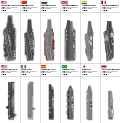 Chart of world navy aircraft carriers.
 -
 USS Abraham Lincoln underway.
 -
 HMS Queen Elizabeth in Gibraltar.
 -
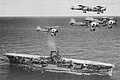 HMS Ark Royal.
 -
 The Japanese seaplane carrier Wakamiya.
 -
 USS Enterprise in Puget Sound, 1945.
 -
 The Japanese aircraft carrier Shinano.


_underway_in_the_Atlantic_Ocean_on_30_January_2019_(190130-N-PW716-1312).JPG)
.jpg)


_in_Puget_Sound,_September_1945.jpg)

Medical Disclaimer: WikiMD is for informational purposes only and is not a substitute for professional medical advice. Content may be inaccurate or outdated and should not be used for diagnosis or treatment. Always consult your healthcare provider for medical decisions. Verify information with trusted sources such as CDC.gov and NIH.gov. By using this site, you agree that WikiMD is not liable for any outcomes related to its content. See full disclaimer.
Credits:Most images are courtesy of Wikimedia commons, and templates, categories Wikipedia, licensed under CC BY SA or similar.
Translate this page: - East Asian
中文,
日本,
한국어,
South Asian
हिन्दी,
தமிழ்,
తెలుగు,
Urdu,
ಕನ್ನಡ,
Southeast Asian
Indonesian,
Vietnamese,
Thai,
မြန်မာဘာသာ,
বাংলা
European
español,
Deutsch,
français,
Greek,
português do Brasil,
polski,
română,
русский,
Nederlands,
norsk,
svenska,
suomi,
Italian
Middle Eastern & African
عربى,
Turkish,
Persian,
Hebrew,
Afrikaans,
isiZulu,
Kiswahili,
Other
Bulgarian,
Hungarian,
Czech,
Swedish,
മലയാളം,
मराठी,
ਪੰਜਾਬੀ,
ગુજરાતી,
Portuguese,
Ukrainian
