Age and female fertility
Overview of the relationship between age and female fertility
Age and female fertility refers to the relationship between a woman's age and her ability to conceive and bear children. Fertility in women is known to decline with age, and this decline becomes more pronounced after the age of 35.
Overview[edit]
Female fertility is closely linked to age. Women are born with a finite number of ovarian follicles, which are the structures in the ovaries that contain immature oocytes or egg cells. As a woman ages, the number and quality of these follicles decrease, leading to reduced fertility.
Biological factors[edit]
The decline in female fertility with age is primarily due to the decrease in both the quantity and quality of oocytes. Women are born with approximately 1 to 2 million oocytes, but this number decreases significantly over time. By puberty, only about 300,000 to 400,000 oocytes remain, and this number continues to decline with age.
Ovarian reserve[edit]
The term ovarian reserve refers to the number of viable oocytes remaining in the ovaries. As women age, their ovarian reserve diminishes, which is a key factor in the decline of fertility. The rate of decline varies among individuals, but it accelerates after the age of 35.
Oocyte quality[edit]
In addition to the decrease in quantity, the quality of oocytes also declines with age. Older oocytes are more likely to have chromosomal abnormalities, which can lead to miscarriage or congenital disorders such as Down syndrome.
[edit]
The decline in fertility with age is a well-documented phenomenon. Women in their 20s and early 30s generally have the highest fertility rates. However, fertility begins to decline in the early 30s and drops more sharply after age 35. By age 40, the chance of natural conception per month is significantly reduced.
Assisted reproductive technologies[edit]
For women experiencing age-related fertility decline, assisted reproductive technologies (ART) such as in vitro fertilization (IVF) can offer potential solutions. However, the success rates of ART also decrease with age, particularly after age 40.
Social and cultural factors[edit]
In recent decades, many women have chosen to delay childbearing for various reasons, including career advancement and personal choice. This trend has led to increased awareness of age-related fertility decline and the potential need for fertility preservation methods such as egg freezing.
Related pages[edit]
Gallery[edit]
-
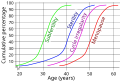 Graph showing the decline in female fertility with age.
 -
 Image of non-growing follicles in the ovary.


-
Age and female fertility
-
Non-Growing Follicles
Ad. Transform your life with W8MD's Budget GLP-1 injections from $49.99


W8MD offers a medical weight loss program to lose weight in Philadelphia. Our physician-supervised medical weight loss provides:
- Weight loss injections in NYC (generic and brand names):
- Zepbound / Mounjaro, Wegovy / Ozempic, Saxenda
- Most insurances accepted or discounted self-pay rates. We will obtain insurance prior authorizations if needed.
- Generic GLP1 weight loss injections from $49.99 for the starting dose of Semaglutide and $65.00 for Tirzepatide.
- Also offer prescription weight loss medications including Phentermine, Qsymia, Diethylpropion, Contrave etc.
NYC weight loss doctor appointmentsNYC weight loss doctor appointments
Start your NYC weight loss journey today at our NYC medical weight loss and Philadelphia medical weight loss clinics.
- Call 718-946-5500 to lose weight in NYC or for medical weight loss in Philadelphia 215-676-2334.
- Tags:NYC medical weight loss, Philadelphia lose weight Zepbound NYC, Budget GLP1 weight loss injections, Wegovy Philadelphia, Wegovy NYC, Philadelphia medical weight loss, Brookly weight loss and Wegovy NYC


|
WikiMD's Wellness Encyclopedia |
| Let Food Be Thy Medicine Medicine Thy Food - Hippocrates |
Medical Disclaimer: WikiMD is not a substitute for professional medical advice. The information on WikiMD is provided as an information resource only, may be incorrect, outdated or misleading, and is not to be used or relied on for any diagnostic or treatment purposes. Please consult your health care provider before making any healthcare decisions or for guidance about a specific medical condition. WikiMD expressly disclaims responsibility, and shall have no liability, for any damages, loss, injury, or liability whatsoever suffered as a result of your reliance on the information contained in this site. By visiting this site you agree to the foregoing terms and conditions, which may from time to time be changed or supplemented by WikiMD. If you do not agree to the foregoing terms and conditions, you should not enter or use this site. See full disclaimer.
Credits:Most images are courtesy of Wikimedia commons, and templates, categories Wikipedia, licensed under CC BY SA or similar.
Translate this page: - East Asian
中文,
日本,
한국어,
South Asian
हिन्दी,
தமிழ்,
తెలుగు,
Urdu,
ಕನ್ನಡ,
Southeast Asian
Indonesian,
Vietnamese,
Thai,
မြန်မာဘာသာ,
বাংলা
European
español,
Deutsch,
français,
Greek,
português do Brasil,
polski,
română,
русский,
Nederlands,
norsk,
svenska,
suomi,
Italian
Middle Eastern & African
عربى,
Turkish,
Persian,
Hebrew,
Afrikaans,
isiZulu,
Kiswahili,
Other
Bulgarian,
Hungarian,
Czech,
Swedish,
മലയാളം,
मराठी,
ਪੰਜਾਬੀ,
ગુજરાતી,
Portuguese,
Ukrainian
