Africanized bee
Africanized bee

The Africanized bee, also known as the Africanized honey bee or killer bee, is a hybrid of the Western honey bee species Apis mellifera. This hybrid originated from the crossbreeding of the East African lowland honey bee Apis mellifera scutellata with various European honey bee subspecies such as Apis mellifera ligustica and Apis mellifera iberiensis.
History[edit]
The Africanized bee was first introduced to the Americas in 1956 when 26 Tanzanian queen bees were brought to Brazil by biologist Warwick E. Kerr. The goal was to increase honey production by crossbreeding with local bees. However, in 1957, some of these bees escaped quarantine and began to spread throughout South and Central America, eventually reaching the southern United States.
Characteristics[edit]
Africanized bees are known for their aggressive behavior compared to other honey bee subspecies. They are more likely to defend their hive and do so with greater numbers. This defensive behavior has earned them the nickname "killer bees." Despite this, they are similar in appearance to other honey bees and can only be distinguished through genetic analysis.
Behavior[edit]
Africanized bees exhibit a high tendency to swarm and abscond, which means they frequently leave their hives to establish new colonies. This behavior contributes to their rapid spread across regions. They are also more likely to pursue perceived threats over longer distances than other honey bee subspecies.
Impact[edit]
The spread of Africanized bees has had significant ecological and economic impacts. They compete with native pollinators and can disrupt local ecosystems. In agriculture, they pose challenges to beekeepers due to their aggressive nature, although they are still valuable pollinators.
Management[edit]
Efforts to manage Africanized bees include breeding programs to reduce their aggressiveness and public education to minimize human-bee conflicts. Beekeepers are advised to use protective gear and maintain calm when working with these bees.
Related pages[edit]
Gallery[edit]
-
 Animation of Africanized bees
 -
 Africanized honey bee hive
 -
 Pollination by honey bees
 -
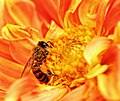 Honey bee taking nectar
 -
 Puerto Rican Africanized bee


Medical Disclaimer: WikiMD is for informational purposes only and is not a substitute for professional medical advice. Content may be inaccurate or outdated and should not be used for diagnosis or treatment. Always consult your healthcare provider for medical decisions. Verify information with trusted sources such as CDC.gov and NIH.gov. By using this site, you agree that WikiMD is not liable for any outcomes related to its content. See full disclaimer.
Credits:Most images are courtesy of Wikimedia commons, and templates, categories Wikipedia, licensed under CC BY SA or similar.
Translate page: - East Asian
中文,
日本,
한국어,
South Asian
हिन्दी,
தமிழ்,
తెలుగు,
Urdu,
ಕನ್ನಡ,
Southeast Asian
Indonesian,
Vietnamese,
Thai,
မြန်မာဘာသာ,
বাংলা
European
español,
Deutsch,
français,
Greek,
português do Brasil,
polski,
română,
русский,
Nederlands,
norsk,
svenska,
suomi,
Italian
Middle Eastern & African
عربى,
Turkish,
Persian,
Hebrew,
Afrikaans,
isiZulu,
Kiswahili,
Other
Bulgarian,
Hungarian,
Czech,
Swedish,
മലയാളം,
मराठी,
ਪੰਜਾਬੀ,
ગુજરાતી,
Portuguese,
Ukrainian

