Acharonim
```wikitext {{Infobox|child= | bodyclass = biography vcard
| abovestyle = font-size:125%;background:
- D3D3D3; color:black
| above =
| subheaderstyle = font-size:125%; font-weight:bold; | subheader =
| image = {{#if:|[[File:|image=|size=|sizedefault=frameless|upright=1|alt=|suppressplaceholder=yes}} | caption =
| headerstyle = background:
- D3D3D3; color:black
| data1 = | data2 =
| label3 = Title | data3 = Acharonim
| label4 = Official name | data4 =
| header6 = Personal life
| label7 = Born | data7 =
| label8 = Died
| data8 =
| label9 = Cause of death
| data9 =
| label10 = Resting place | data10 =
| class11 = nickname
| label11 = Nationality
| data11 =
| label12 = Flourished | data12 =
| label13 = Home town | data13 =
| label14 = Spouse | data14 =
| label15 = Children | data15 =
| label16 = Parent | data16 =
| label17 = Citizenship | data17 =
| label20 = Dynasty | data20 =
| label21 = Region | data21 =
| label29 = Political party | data29 =
| label30 = Main interest(s) | data30 =
| label31 = Notable idea(s) | data31 =
| label32 = Notable work(s) | data32 =
| label33 = Alma mater | data33 =
| label36 = Known for | data36 =
| class37 = nickname | label37 = Other names | data37 =
| class40 = nickname | label40 = Pen name | data40 =
| class41 = nickname | label41 = Posthumous name | data41 =
| label43 = Occupation | data43 = Rabbinic scholars
| label44 = Relatives | data44 =
| data45 =
| label46 = Honours | data46 =
| label47 = Signature | data47 = {{#if:|[[File:|image=|size=|sizedefault=150px|alt=}}
| header67 = Religious life
| class68 = category | label68 = Religion | data68 = Judaism
| class69 = category | label69 = Denomination | data69 =
| label70 = Temple | data70 =
| label71 = Order | data71 =
| label72 = Institute | data72 =
| label73 = Church | data73 =
| label74 = Founder of | data74 =
| label75 = Philosophy | data75 =
| class76 = category | label76 = School | data76 =
| label77 = Lineage | data77 =
| class78 = category | label78 = Sect | data78 =
| class79 = category
| label79 = Jurisprudence
| data79 =
| label80 = Teachers | data80 =
| label81 = Tariqa | data81 =
| class82 = category | label82 = Creed | data82 =
| label83 = Movement | data83 =
| class84 = nickname | label84 = Dharma names | data84 =
| class85 = nickname | label85 = Monastic name | data85 =
| label86 = Profession | data86 =
| label87 = Ordination | data87 =
| label88 = Consecration | data88 =
| label90 = Initiation | data90 =
| label91 = Initiation
| data91 =
| header92 =
| label93 = Teacher | data93 =
| class94 = label | label94 = Based in | data94 =
| label95 = Present post | data95 =
| label96 = Post | data96 =
| label97 = Period in office | data97 =
| label98 = Predecessor | data98 =
| label99 = Successor | data99 =
| label100 = Reason for exit | data100 =
| label101 = Previous post | data101 =
| label102 = Reincarnation | data102 =
| label103 = Disciple of | data103 =
| data104 =
| data105 =
| label106 = Initiated | data106 =
| data107 =
| data108 =
| header109 =
| label110 = Nickname(s) | data110 =
| label111 = Allegiance | data111 =
| label112 = Service/branch | data112 =
| label113 = Years of service | data113 =
| label114 = Rank | data114 =
| label115 = Unit | data115 =
| label116 = Commands | data116 =
| label117 = Battles/wars | data117 =
| label118 = Awards | data118 =
| label119 = {{{military_blank1}}} | data119 =
| label120 = {{{military_blank2}}} | data120 =
| label121 = {{{military_blank3}}} | data121 =
| label122 = {{{military_blank4}}} | data122 =
| label123 = {{{military_blank5}}} | data123 =
| data124 = | data125 = | data126 = | data127 = | data128 =
| label129 = Website | data129 =
| belowstyle = text-align:left; border-top:1px #aaa solid;
| below =
}}
| Compare image with Wikidata | ||||||||||
|---|---|---|---|---|---|---|---|---|---|---|
This image comparison related article is a stub.
|
The Acharonim (Hebrew: אחרונים; "Last Ones") are the leading rabbinic authorities and scholars who lived from approximately the 16th century to the present day. This era follows the period of the Rishonim, the "First Ones," who lived from approximately the 11th to the 15th centuries.
Historical Context[edit]
The Acharonim period began after the codification of the Shulchan Aruch by Rabbi Joseph Caro in the 16th century. This era is marked by the development of new halachic (Jewish legal) literature and the response to modernity and changing circumstances in Jewish life.
Notable Acharonim[edit]
Some of the most prominent Acharonim include:
- Rabbi Moses Isserles (the "Rema")
- Rabbi Elijah of Vilna (the "Vilna Gaon")
- Rabbi Chaim Joseph David Azulai (the "Chida")
- Rabbi Moshe Feinstein
- Rabbi Joseph B. Soloveitchik
Contributions[edit]
The Acharonim have contributed significantly to Jewish thought, law, and philosophy. They have written extensive commentaries on the Talmud, Shulchan Aruch, and other key texts. Their works address both traditional Jewish law and contemporary issues, providing guidance for Jewish communities worldwide.
Influence[edit]
The influence of the Acharonim extends to all areas of Jewish life, including education, ritual, and community leadership. Their interpretations and rulings continue to shape modern Orthodox Judaism and other Jewish movements.
See Also[edit]
References[edit]
External Links[edit]
 | This Judaism-related article is a stub. You can help WikiMD by expanding the page. |
-
 Isaac Aboab Fonseca
 -
 Brockhaus and Efron Jewish Encyclopedia
 -
 Naftali Tzvi Yehuda Berlin (ha-Natziv)
 -
 Israel Meir Poupko, tefillin
 -
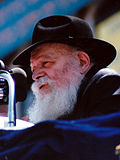 Rabbi Menachem Mendel Schneerson
 -
 Ovadia Yosef


_1a.jpg)


Medical Disclaimer: WikiMD is for informational purposes only and is not a substitute for professional medical advice. Content may be inaccurate or outdated and should not be used for diagnosis or treatment. Always consult your healthcare provider for medical decisions. Verify information with trusted sources such as CDC.gov and NIH.gov. By using this site, you agree that WikiMD is not liable for any outcomes related to its content. See full disclaimer.
Credits:Most images are courtesy of Wikimedia commons, and templates, categories Wikipedia, licensed under CC BY SA or similar.
Translate this page: - East Asian
中文,
日本,
한국어,
South Asian
हिन्दी,
தமிழ்,
తెలుగు,
Urdu,
ಕನ್ನಡ,
Southeast Asian
Indonesian,
Vietnamese,
Thai,
မြန်မာဘာသာ,
বাংলা
European
español,
Deutsch,
français,
Greek,
português do Brasil,
polski,
română,
русский,
Nederlands,
norsk,
svenska,
suomi,
Italian
Middle Eastern & African
عربى,
Turkish,
Persian,
Hebrew,
Afrikaans,
isiZulu,
Kiswahili,
Other
Bulgarian,
Hungarian,
Czech,
Swedish,
മലയാളം,
मराठी,
ਪੰਜਾਬੀ,
ગુજરાતી,
Portuguese,
Ukrainian
