Accessory obturator nerve
The accessory obturator nerve is a nerve in the human body that is present in approximately 10% of the population. It is considered an anatomical variant and is part of the lumbar plexus.
Anatomy[edit]
The accessory obturator nerve arises from the ventral divisions of the third and fourth lumbar nerves (L3 and L4). It is a branch of the lumbar plexus, which is a network of nerves in the lower back that supplies the lower limb.
The nerve descends along the medial border of the psoas major muscle, and it passes over the superior pubic ramus. It then enters the thigh, where it supplies the pectineus muscle.
Function[edit]
The primary function of the accessory obturator nerve is to innervate the pectineus muscle, which is involved in hip flexion and adduction. In some cases, it may also provide sensory innervation to the hip joint and the medial thigh.
Clinical significance[edit]
The presence of the accessory obturator nerve can have clinical implications, particularly in surgical procedures involving the pelvis or hip joint. Surgeons must be aware of its possible presence to avoid inadvertent injury during operations such as hip replacement surgery.
In cases where the accessory obturator nerve is present, it may contribute to the innervation of the hip joint, and its injury could lead to sensory deficits or weakness in the medial thigh.
Related pages[edit]
Gallery[edit]
-
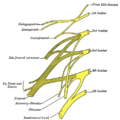 Diagram of the lumbar plexus with the accessory obturator nerve.
 -
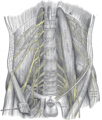 The accessory obturator nerve in relation to the psoas major muscle.


Accessory obturator nerve[edit]

Medical Disclaimer: WikiMD is for informational purposes only and is not a substitute for professional medical advice. Content may be inaccurate or outdated and should not be used for diagnosis or treatment. Always consult your healthcare provider for medical decisions. Verify information with trusted sources such as CDC.gov and NIH.gov. By using this site, you agree that WikiMD is not liable for any outcomes related to its content. See full disclaimer.
Credits:Most images are courtesy of Wikimedia commons, and templates, categories Wikipedia, licensed under CC BY SA or similar.
Translate page: - East Asian
中文,
日本,
한국어,
South Asian
हिन्दी,
தமிழ்,
తెలుగు,
Urdu,
ಕನ್ನಡ,
Southeast Asian
Indonesian,
Vietnamese,
Thai,
မြန်မာဘာသာ,
বাংলা
European
español,
Deutsch,
français,
Greek,
português do Brasil,
polski,
română,
русский,
Nederlands,
norsk,
svenska,
suomi,
Italian
Middle Eastern & African
عربى,
Turkish,
Persian,
Hebrew,
Afrikaans,
isiZulu,
Kiswahili,
Other
Bulgarian,
Hungarian,
Czech,
Swedish,
മലയാളം,
मराठी,
ਪੰਜਾਬੀ,
ગુજરાતી,
Portuguese,
Ukrainian

