3-Methoxytyramine
A metabolite of dopamine
| Chemical Compound | |
|---|---|
| Identifiers | |
| CAS Number | |
| PubChem CID | |
| ChemSpider ID | |
| UNII | |
| ChEBI | |
| ChEMBL | |
| Properties | |
| Chemical Formula | |
| Molar Mass | |
| Appearance | |
| Density | |
| Melting Point | |
| Boiling Point | |
| Hazards | |
| GHS Pictograms | [[File:|50px]] |
| GHS Signal Word | |
| GHS Hazard Statements | |
| NFPA 704 | [[File:|50px]] |
| References | |
3-Methoxytyramine (3-MT) is a catecholamine and a metabolite of the neurotransmitter dopamine. It is formed by the action of the enzyme catechol-O-methyltransferase (COMT) on dopamine.
Biochemistry[edit]
3-Methoxytyramine is produced in the brain and other tissues as part of the dopamine metabolism pathway. When dopamine is released into the synaptic cleft, it can be taken back up into the presynaptic neuron, degraded by monoamine oxidase (MAO), or metabolized by COMT to form 3-MT. This process is part of the regulation of dopamine levels in the central nervous system.
Function[edit]
While 3-Methoxytyramine was traditionally considered an inactive metabolite, recent research suggests it may have biological activity of its own. It has been proposed to act as a neuromodulator and may influence dopaminergic signaling in the brain. However, the exact physiological role of 3-MT is still under investigation.
Clinical significance[edit]
The levels of 3-Methoxytyramine in the body can be indicative of certain medical conditions. Elevated levels may be associated with pheochromocytoma, a type of tumor that can affect catecholamine production. Measuring 3-MT levels can be part of the diagnostic process for such conditions.
Synthesis[edit]
In the laboratory, 3-Methoxytyramine can be synthesized through the methylation of tyramine using methylating agents. This process is useful for research purposes and for the study of its properties and potential effects.
Related pages[edit]
Gallery[edit]
-
 Structural formula of 3-Methoxytyramine
 -
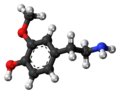 3D ball-and-stick model of 3-Methoxytyramine


Advertise on WikiMD — 81,000+ full articles, ~900,000 total pages, ~250 million page views. Global reach, limited time promotional rates from $1/page/day. Learn more · View stats

Translate page: - East Asian
中文,
日本,
한국어,
South Asian
हिन्दी,
தமிழ்,
తెలుగు,
Urdu,
ಕನ್ನಡ,
Southeast Asian
Indonesian,
Vietnamese,
Thai,
မြန်မာဘာသာ,
বাংলা
European
español,
Deutsch,
français,
Greek,
português do Brasil,
polski,
română,
русский,
Nederlands,
norsk,
svenska,
suomi,
Italian
Middle Eastern & African
عربى,
Turkish,
Persian,
Hebrew,
Afrikaans,
isiZulu,
Kiswahili,
Other
Bulgarian,
Hungarian,
Czech,
Swedish,
മലയാളം,
मराठी,
ਪੰਜਾਬੀ,
ગુજરાતી,
Portuguese,
Ukrainian
About WikiMD • Contact • Disclaimer • Privacy • Copyright • Site statistics
Some content and images may originate from Wikimedia Commons or Wikipedia and remain subject to their stated licenses. Unless otherwise noted, eligible WikiMD content is available under CC BY-SA 4.0.
WikiMD Wellnesspedia — Free health & wellness information for patients, students, and health professionals.

