Chronology of the universe
Chronology of the Universe details the history and future of the universe according to current scientific understanding. This chronology outlines significant events from the very beginning of the universe through its major epochs, to the present day, and projects into the future based on theoretical predictions. The study of the universe's chronology involves multiple scientific disciplines including astronomy, cosmology, and physics.
The Big Bang[edit]
The chronology of the universe begins with the Big Bang, an event occurring approximately 13.8 billion years ago, which marks the origin of the universe. At this moment, all matter, energy, space, and time were created. The universe initially existed in an extremely hot and dense state and has since been expanding and cooling.
The Planck Epoch[edit]
Immediately following the Big Bang, the universe entered the Planck Epoch, lasting for a mere 10^-43 seconds. During this time, the four fundamental forces (gravity, electromagnetism, the strong nuclear force, and the weak nuclear force) were unified. The physics of this epoch is still not fully understood and is the subject of ongoing research in theoretical physics.
The Grand Unification Epoch[edit]
Following the Planck Epoch, the universe entered the Grand Unification Epoch, where the temperature of the universe cooled sufficiently to allow the separation of the strong force from the electroweak force (a combination of electromagnetism and the weak nuclear force). This epoch lasted until approximately 10^-36 seconds after the Big Bang.
Inflationary Epoch[edit]
The Inflationary Epoch occurred roughly between 10^-36 seconds and 10^-32 seconds after the Big Bang. During this period, the universe underwent an extremely rapid exponential expansion. This expansion smoothed out any irregularities and homogenized the observable universe.
Electroweak Epoch[edit]
Following inflation, the universe cooled further, allowing the electroweak force to split into the distinct forces of electromagnetism and the weak nuclear force. This period is known as the Electroweak Epoch.
Quark Epoch[edit]
The Quark Epoch followed, during which the universe was filled with a hot, dense plasma of quarks, antiquarks, and gluons. As the universe continued to cool, quarks and antiquarks began to annihilate each other, leading to a slight surplus of quarks, which would eventually form matter.
Hadron Epoch[edit]
The Hadron Epoch saw the combination of quarks into hadrons, including protons and neutrons. The majority of the antimatter that existed was annihilated during this time, leaving a small excess of matter.
Lepton Epoch[edit]
During the Lepton Epoch, leptons (such as electrons) were the dominant form of matter. The universe continued to cool, allowing electrons and nuclei to eventually combine and form neutral atoms.
Photon Epoch[edit]
The Photon Epoch is characterized by the dominance of photons in the universe. During this time, the universe became transparent to photons, allowing light to travel freely.
Formation of the First Stars and Galaxies[edit]
Several hundred million years after the Big Bang, the first stars and galaxies began to form. This period, known as the Cosmic Dawn, marked the end of the universe's "dark ages."
Present Day[edit]
Currently, the universe is 13.8 billion years old and continues to expand. The study of cosmic microwave background radiation provides evidence for the Big Bang theory and offers insights into the early universe's conditions.
Future of the Universe[edit]
The future of the universe is subject to various theories. The most widely accepted scenario is that it will continue to expand indefinitely, leading to a state known as the Heat Death of the Universe, where it will reach maximum entropy.

-
 CMB Timeline 300 no WMAP
 -
 Age by redshift
 -
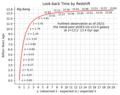 Look-back time by redshift
 -
 WMAP 2012
 -
 NASA WMAP first stars
 -
 Hubble ultra deep field
 -
 Hubble - infant galaxy
 -
 Conditions During the Era of Reionization (Illustration)
 -
 Large-scale structure of light distribution in the universe


_(2023-122).jpg)

Ad. Transform your health with W8MD Weight Loss, Sleep & MedSpa

Tired of being overweight?
Special offer:
Budget GLP-1 weight loss medications
- Semaglutide starting from $29.99/week and up with insurance for visit of $59.99 and up per week self pay.
- Tirzepatide starting from $45.00/week and up (dose dependent) or $69.99/week and up self pay
✔ Same-week appointments, evenings & weekends
Learn more:
- GLP-1 weight loss clinic NYC
- W8MD's NYC medical weight loss
- W8MD Philadelphia GLP-1 shots
- Philadelphia GLP-1 injections
- Affordable GLP-1 shots NYC
|
WikiMD Medical Encyclopedia |
Medical Disclaimer: WikiMD is for informational purposes only and is not a substitute for professional medical advice. Content may be inaccurate or outdated and should not be used for diagnosis or treatment. Always consult your healthcare provider for medical decisions. Verify information with trusted sources such as CDC.gov and NIH.gov. By using this site, you agree that WikiMD is not liable for any outcomes related to its content. See full disclaimer.
Credits:Most images are courtesy of Wikimedia commons, and templates, categories Wikipedia, licensed under CC BY SA or similar.
Translate this page: - East Asian
中文,
日本,
한국어,
South Asian
हिन्दी,
தமிழ்,
తెలుగు,
Urdu,
ಕನ್ನಡ,
Southeast Asian
Indonesian,
Vietnamese,
Thai,
မြန်မာဘာသာ,
বাংলা
European
español,
Deutsch,
français,
Greek,
português do Brasil,
polski,
română,
русский,
Nederlands,
norsk,
svenska,
suomi,
Italian
Middle Eastern & African
عربى,
Turkish,
Persian,
Hebrew,
Afrikaans,
isiZulu,
Kiswahili,
Other
Bulgarian,
Hungarian,
Czech,
Swedish,
മലയാളം,
मराठी,
ਪੰਜਾਬੀ,
ગુજરાતી,
Portuguese,
Ukrainian
