Gymnopilus luteofolius

Gymnopilus luteofolius is a species of mushroom belonging to the family Hymenogastraceae. It is known for its distinctive yellowish-brown cap and preference for growing on hardwood logs and stumps. This mushroom is part of the larger Gymnopilus genus, which encompasses a variety of species, some of which are noted for their psychoactive properties due to the presence of compounds such as psilocybin. However, the specific psychoactive properties of Gymnopilus luteofolius itself are less well-documented, and it is primarily of interest for its ecological role and distinctive appearance.
Description[edit]
Gymnopilus luteofolius features a cap that ranges from 3 to 8 cm in diameter, initially convex before flattening out with age. The cap's surface is smooth and dry, with a yellowish-brown coloration that can vary in intensity. The gills are adnate to adnexed, crowded, and display a similar yellowish color, which becomes more rusty-brown with spore maturity. The stem is typically 2 to 5 cm in length and 0.5 to 1 cm thick, often with a more vivid yellow color at the top, near the gills, and a brownish base.
The spore print of Gymnopilus luteofolius is a distinguishing feature, typically rust-brown, which is common among members of the Gymnopilus genus. Microscopically, the spores are ellipsoid, with a rough surface, measuring 6 to 8 by 4 to 5 micrometers.
Habitat and Distribution[edit]
Gymnopilus luteofolius is primarily found in North America, particularly in wooded areas where it grows saprotrophically on the wood of hardwood trees. It is most commonly observed from late summer to fall. This species prefers the decaying wood of trees such as oaks and maples, contributing to the decomposition process and nutrient cycling within forest ecosystems.
Taxonomy[edit]
The taxonomy of Gymnopilus luteofolius has been subject to revision, like many fungi, as molecular techniques have provided new insights into relationships within the Hymenogastraceae family. It was first described scientifically in the early 20th century and has undergone various reclassifications over the years. The genus Gymnopilus is characterized by its rusty spore print, lignicolous (wood-dwelling) habitat, and often bitter taste, although Gymnopilus luteofolius is not noted for being particularly bitter.
Culinary and Medicinal Use[edit]
There is no significant record of Gymnopilus luteofolius being used for culinary or medicinal purposes. While some species within the Gymnopilus genus are sought after for their psychoactive properties, Gymnopilus luteofolius does not have a well-documented history of human use in this context. As with all wild mushrooms, caution is advised when identifying and consuming them due to the risk of mistaking them for toxic species.
See Also[edit]

Gymnopilus luteofolius gallery[edit]
-
 Gymnopilus luteofolius Washington
 -
 Gymnopilus luteofolius Washington pair
 -
 Gymnopilus luteofolius spores 1000x
 -
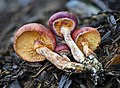 Gymnopilus luteofolius Washington gills


Ad. Transform your health with W8MD Weight Loss, Sleep & MedSpa

Tired of being overweight?
Special offer:
Budget GLP-1 weight loss medications
- Semaglutide starting from $29.99/week and up with insurance for visit of $59.99 and up per week self pay.
- Tirzepatide starting from $45.00/week and up (dose dependent) or $69.99/week and up self pay
✔ Same-week appointments, evenings & weekends
Learn more:
- GLP-1 weight loss clinic NYC
- W8MD's NYC medical weight loss
- W8MD Philadelphia GLP-1 shots
- Philadelphia GLP-1 injections
- Affordable GLP-1 shots NYC
|
WikiMD Medical Encyclopedia |
Medical Disclaimer: WikiMD is for informational purposes only and is not a substitute for professional medical advice. Content may be inaccurate or outdated and should not be used for diagnosis or treatment. Always consult your healthcare provider for medical decisions. Verify information with trusted sources such as CDC.gov and NIH.gov. By using this site, you agree that WikiMD is not liable for any outcomes related to its content. See full disclaimer.
Credits:Most images are courtesy of Wikimedia commons, and templates, categories Wikipedia, licensed under CC BY SA or similar.
Translate this page: - East Asian
中文,
日本,
한국어,
South Asian
हिन्दी,
தமிழ்,
తెలుగు,
Urdu,
ಕನ್ನಡ,
Southeast Asian
Indonesian,
Vietnamese,
Thai,
မြန်မာဘာသာ,
বাংলা
European
español,
Deutsch,
français,
Greek,
português do Brasil,
polski,
română,
русский,
Nederlands,
norsk,
svenska,
suomi,
Italian
Middle Eastern & African
عربى,
Turkish,
Persian,
Hebrew,
Afrikaans,
isiZulu,
Kiswahili,
Other
Bulgarian,
Hungarian,
Czech,
Swedish,
മലയാളം,
मराठी,
ਪੰਜਾਬੀ,
ગુજરાતી,
Portuguese,
Ukrainian
