René Descartes

René Descartes (31 March 1596 – 11 February 1650) was a French philosopher, mathematician, and scientist. Dubbed the father of modern western philosophy, much of subsequent Western philosophy is a response to his writings, which are studied closely to this day. Descartes' Meditations on First Philosophy continues to be a standard text at most university philosophy departments. Descartes' influence in mathematics is equally apparent; the Cartesian coordinate system — allowing geometric shapes to be expressed in algebraic equations — was named after him. He is credited as the father of analytical geometry, the bridge between algebra and geometry, crucial to the invention of calculus and analysis.
Life[edit]
Descartes was born in La Haye en Touraine, France, in 1596. After completing his education at the Jesuit college of La Flèche, he studied at the University of Poitiers, earning a Baccalauréat and Licence in law in 1616, in accordance with his father's wishes that he should become a lawyer. However, after a brief period of practicing law, Descartes decided that his real path in life was the pursuit of true wisdom and science. He traveled extensively throughout Europe, joining various armies and witnessing various battles, before dedicating himself entirely to the study of philosophy and mathematics.
Philosophical Contributions[edit]
Descartes is perhaps best known for the philosophical statement "Cogito, ergo sum" ("I think, therefore I am"), found in his Discourse on the Method (1637) and Principles of Philosophy (1644). This proposition became a fundamental element of Western philosophy, as it purported to provide a secure foundation for knowledge in the face of radical doubt. Descartes' method of doubt led him to question every belief about the external world and his own body, but he concluded that the act of doubting itself presupposed the existence and consciousness of a doubting self. This insight is often seen as the birth of modern subjectivity, or the "turn to the subject." In addition to his work in philosophy, Descartes' contributions to mathematics are profound. He developed the Cartesian coordinate system and contributed significantly to the field of analytical geometry, which allowed for the solving of geometric problems through algebra. His work provided the basis for the calculus developed by Newton and Leibniz.
Scientific Contributions[edit]
Descartes also made significant contributions to the field of optics and is known for his laws of refraction. In physiology, he described the reflex arc concept, which has played a fundamental role in the development of theories of the nervous system.
Legacy[edit]
Descartes' work in philosophy, mathematics, and science had a profound impact on various fields and laid the groundwork for many modern disciplines. His method of doubt and emphasis on the use of reason to establish truth has influenced countless philosophers and scientists. Despite the controversy some of his theories have generated, his work remains a cornerstone of Western thought.
See Also[edit]

This article is a philosophy-related stub. You can help WikiMD by expanding it!
-
 Portrait of René Descartes by Frans Hals
 -
 Signature of René Descartes
 -
 Coat of arms of the Descartes family
 -
 House of René Descartes
 -
 Descartes' graduation registry
 -
 Descartes House at Westermarkt 6
 -
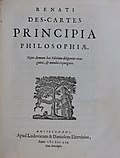 René Descartes


.JPG)

Ad. Transform your health with W8MD Weight Loss, Sleep & MedSpa

Tired of being overweight?
Special offer:
Budget GLP-1 weight loss medications
- Semaglutide starting from $29.99/week and up with insurance for visit of $59.99 and up per week self pay.
- Tirzepatide starting from $45.00/week and up (dose dependent) or $69.99/week and up self pay
✔ Same-week appointments, evenings & weekends
Learn more:
- GLP-1 weight loss clinic NYC
- W8MD's NYC medical weight loss
- W8MD Philadelphia GLP-1 shots
- Philadelphia GLP-1 injections
- Affordable GLP-1 shots NYC
|
WikiMD Medical Encyclopedia |
Medical Disclaimer: WikiMD is for informational purposes only and is not a substitute for professional medical advice. Content may be inaccurate or outdated and should not be used for diagnosis or treatment. Always consult your healthcare provider for medical decisions. Verify information with trusted sources such as CDC.gov and NIH.gov. By using this site, you agree that WikiMD is not liable for any outcomes related to its content. See full disclaimer.
Credits:Most images are courtesy of Wikimedia commons, and templates, categories Wikipedia, licensed under CC BY SA or similar.
Translate this page: - East Asian
中文,
日本,
한국어,
South Asian
हिन्दी,
தமிழ்,
తెలుగు,
Urdu,
ಕನ್ನಡ,
Southeast Asian
Indonesian,
Vietnamese,
Thai,
မြန်မာဘာသာ,
বাংলা
European
español,
Deutsch,
français,
Greek,
português do Brasil,
polski,
română,
русский,
Nederlands,
norsk,
svenska,
suomi,
Italian
Middle Eastern & African
عربى,
Turkish,
Persian,
Hebrew,
Afrikaans,
isiZulu,
Kiswahili,
Other
Bulgarian,
Hungarian,
Czech,
Swedish,
മലയാളം,
मराठी,
ਪੰਜਾਬੀ,
ગુજરાતી,
Portuguese,
Ukrainian
