Braising

#file]]

Braising is a cooking method that involves the combination of moist heat and dry heat to break down the fibers in tough cuts of meat and vegetables. This technique is commonly used in cuisines around the world to create flavorful and tender dishes.
Technique[edit]
Braising typically involves two main steps:
- Browning: The food, usually meat, is first browned in a small amount of fat in a pan or pot. This step adds flavor through the Maillard reaction.
- Simmering: After browning, the food is partially submerged in a liquid such as broth, wine, or water. The pot is then covered and the food is cooked slowly at a low temperature, either on the stovetop or in the oven.
The combination of dry and moist heat helps to break down the collagen in the meat, resulting in a tender and flavorful dish.
Common Braised Dishes[edit]
Some popular braised dishes include:
Equipment[edit]
The following equipment is commonly used for braising:
Benefits[edit]
Braising is particularly beneficial for:
- Tough cuts of meat: The slow cooking process helps to tenderize tougher cuts of meat, making them more palatable.
- Flavor development: The browning step adds depth of flavor, while the slow cooking allows the flavors to meld together.
- Nutrient retention: The cooking liquid can be used as a sauce, retaining the nutrients that may otherwise be lost.
Related Pages[edit]

Braising[edit]
-
 Braised Ox Cheek in Star Anise and Soy Sauce
 -
 Pot Roast
 -
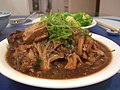 Braised Pork Spare Ribs with Preserved Mustard Greens
 -
 Braised Baby Artichokes
 -
 Braised Pork Belly


Ad. Transform your health with W8MD Weight Loss, Sleep & MedSpa

Tired of being overweight?
Special offer:
Budget GLP-1 weight loss medications
- Semaglutide starting from $29.99/week and up with insurance for visit of $59.99 and up per week self pay.
- Tirzepatide starting from $45.00/week and up (dose dependent) or $69.99/week and up self pay
✔ Same-week appointments, evenings & weekends
Learn more:
- GLP-1 weight loss clinic NYC
- W8MD's NYC medical weight loss
- W8MD Philadelphia GLP-1 shots
- Philadelphia GLP-1 injections
- Affordable GLP-1 shots NYC
|
WikiMD Medical Encyclopedia |
Medical Disclaimer: WikiMD is for informational purposes only and is not a substitute for professional medical advice. Content may be inaccurate or outdated and should not be used for diagnosis or treatment. Always consult your healthcare provider for medical decisions. Verify information with trusted sources such as CDC.gov and NIH.gov. By using this site, you agree that WikiMD is not liable for any outcomes related to its content. See full disclaimer.
Credits:Most images are courtesy of Wikimedia commons, and templates, categories Wikipedia, licensed under CC BY SA or similar.
Translate this page: - East Asian
中文,
日本,
한국어,
South Asian
हिन्दी,
தமிழ்,
తెలుగు,
Urdu,
ಕನ್ನಡ,
Southeast Asian
Indonesian,
Vietnamese,
Thai,
မြန်မာဘာသာ,
বাংলা
European
español,
Deutsch,
français,
Greek,
português do Brasil,
polski,
română,
русский,
Nederlands,
norsk,
svenska,
suomi,
Italian
Middle Eastern & African
عربى,
Turkish,
Persian,
Hebrew,
Afrikaans,
isiZulu,
Kiswahili,
Other
Bulgarian,
Hungarian,
Czech,
Swedish,
മലയാളം,
मराठी,
ਪੰਜਾਬੀ,
ગુજરાતી,
Portuguese,
Ukrainian
