Richard Dawkins
Richard Dawkins is a British ethologist, evolutionary biologist, and author who has significantly influenced the public understanding of science, particularly in the field of evolutionary biology. Born on March 26, 1941, in Nairobi, Kenya, Dawkins grew up in England and was educated at the University of Oxford, where he studied under the renowned ethologist Niko Tinbergen. Dawkins's work has focused on the gene-centered view of evolution, a perspective that has been highly influential in both scientific circles and popular science literature.
Early Life and Education[edit]
Dawkins was born in Nairobi, Kenya, where his father was stationed during World War II. His family returned to England when he was eight years old. Dawkins developed an early interest in the natural world, which led him to pursue zoology at Balliol College, Oxford. Under the mentorship of Niko Tinbergen, Dawkins completed his doctorate in animal behavior in 1966.
Career[edit]
After completing his doctorate, Dawkins worked as an assistant professor of zoology at the University of California, Berkeley, for two years before returning to Oxford as a lecturer. In 1976, he published The Selfish Gene, a book that popularized the idea of the gene as the principal unit of selection in evolution. This book, along with his subsequent works, including The Extended Phenotype and The Blind Watchmaker, has made significant contributions to the public's understanding of evolution.
Dawkins is also known for his outspoken criticism of creationism and intelligent design, arguing that evolution provides a comprehensive explanation for the diversity of life on Earth. His 2006 book, The God Delusion, challenges theistic beliefs and has been a bestseller in multiple countries.
Public Engagement[edit]
Beyond his academic and literary contributions, Dawkins has been a prominent figure in public debates concerning science and religion. He has made numerous television and radio appearances and has utilized social media and other online platforms to discuss and promote scientific literacy. Dawkins founded the Richard Dawkins Foundation for Reason and Science in 2006, aiming to promote secularism and scientific education.
Awards and Recognition[edit]
Dawkins has received numerous awards for his work, including the Royal Society of Literature Award and the Michael Faraday Award presented by the Royal Society. His influence extends beyond biology and into the broader cultural discussion on science and religion.
Criticism and Controversy[edit]
While Dawkins's contributions to science and public discourse are widely recognized, his outspoken criticism of religion has attracted controversy and criticism. Some accuse him of adopting an overly confrontational approach, which, they argue, may be counterproductive in fostering a constructive dialogue between science and religion.
Legacy[edit]
Richard Dawkins's work has left an indelible mark on the fields of evolutionary biology and the public understanding of science. His advocacy for rationalism and scientific inquiry continues to inspire and provoke debate across the globe.
See Also[edit]
| Person Data | ||||||||||
|---|---|---|---|---|---|---|---|---|---|---|
|

-
 Dinner with Richard Dawkins and CFI
 -
 Oundle Great Hall
 -
 Dawkins at UT Austin
 -
 Richard Dawkins Cooper Union Shankbone
 -
 Richard Dawkins Lecture
 -
 Dawkins at AA Conference
 -
 Ariane Sherine and Richard Dawkins at the Atheist Bus Campaign launch
 -
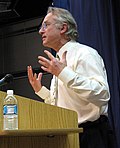 Richard Dawkin Kepler Talk


Ad. Transform your life with W8MD's
GLP-1 weight loss injections special from $29.99 with insurance
|
WikiMD Medical Encyclopedia |
Medical Disclaimer: WikiMD is for informational purposes only and is not a substitute for professional medical advice. Content may be inaccurate or outdated and should not be used for diagnosis or treatment. Always consult your healthcare provider for medical decisions. Verify information with trusted sources such as CDC.gov and NIH.gov. By using this site, you agree that WikiMD is not liable for any outcomes related to its content. See full disclaimer.
Credits:Most images are courtesy of Wikimedia commons, and templates, categories Wikipedia, licensed under CC BY SA or similar.
Translate this page: - East Asian
中文,
日本,
한국어,
South Asian
हिन्दी,
தமிழ்,
తెలుగు,
Urdu,
ಕನ್ನಡ,
Southeast Asian
Indonesian,
Vietnamese,
Thai,
မြန်မာဘာသာ,
বাংলা
European
español,
Deutsch,
français,
Greek,
português do Brasil,
polski,
română,
русский,
Nederlands,
norsk,
svenska,
suomi,
Italian
Middle Eastern & African
عربى,
Turkish,
Persian,
Hebrew,
Afrikaans,
isiZulu,
Kiswahili,
Other
Bulgarian,
Hungarian,
Czech,
Swedish,
മലയാളം,
मराठी,
ਪੰਜਾਬੀ,
ગુજરાતી,
Portuguese,
Ukrainian
