Democracy
Democracy is a form of government in which the people have the authority to choose their governing legislation. Who people are and how authority is shared among them are core issues for democratic theory, development and constitution. Some cornerstones of these issues are freedom of assembly and speech, inclusiveness and equality, membership, consent, voting, right to life and minority rights.
Generally, there are two types of democracies: direct and representative. In a direct democracy, the citizens as a whole form a governing body and vote directly on each issue. In a representative democracy the citizens elect representatives from among themselves. These representatives meet to form a governing body, such as a legislature.
Types of Democracy[edit]
Direct Democracy[edit]
In a Direct Democracy, the citizens as a whole form a governing body and vote directly on each issue. This form of democracy allows the citizens to participate actively in the decision-making process.
Representative Democracy[edit]
In a Representative Democracy, the citizens elect representatives from among themselves. These representatives meet to form a governing body, such as a legislature. This form of democracy allows the citizens to choose their representatives who will make decisions on their behalf.
Principles of Democracy[edit]
Democracy is based on the principles of equality, freedom, and consent. These principles ensure that every individual has an equal opportunity to participate in the democratic process, that they are free to express their opinions and beliefs, and that the government is established with the consent of the governed.
Equality[edit]
In a democracy, all individuals are equal before the law. This principle is known as Equality.
Freedom[edit]
Freedom is another fundamental principle of democracy. It includes freedom of speech, freedom of assembly, and freedom of the press.
Consent[edit]
The principle of Consent means that the authority of a government should depend on the consent of the people, as expressed by votes in elections.
Challenges to Democracy[edit]
Despite its many advantages, democracy also faces several challenges. These include the risk of majority rule leading to tyranny, the potential for manipulation by special interest groups, and the possibility of voter apathy or ignorance.
See Also[edit]
 | |
|---|---|
 |
 |
-
 Mandela voting in 1994
 -
 President Prabowo Subianto in 2024 with decorations
 -
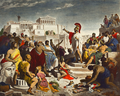 Discurso funebre pericles
 -
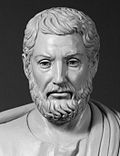 Cleisthenes
 -
 Austria Parlament Athena
 -
 Magna Carta (British Library Cotton MS Augustus II.106)
 -
 House of Commons during King Charles I's reign, circa 1640-1642
 -
 John Locke
 -
 The House of Commons 1793-94 by Karl Anton Hickel
 -
 Declaration of Independence (1819), by John Trumbull
 -
 Declaration of the Rights of Man and of the Citizen in 1789
 -
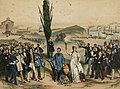 Suffrage universel 1848


.jpg)


,_by_John_Trumbull.jpg)


Ad. Transform your health with W8MD Weight Loss, Sleep & MedSpa

Tired of being overweight?
Special offer:
Budget GLP-1 weight loss medications
- Semaglutide starting from $29.99/week and up with insurance for visit of $59.99 and up per week self pay.
- Tirzepatide starting from $45.00/week and up (dose dependent) or $69.99/week and up self pay
✔ Same-week appointments, evenings & weekends
Learn more:
- GLP-1 weight loss clinic NYC
- W8MD's NYC medical weight loss
- W8MD Philadelphia GLP-1 shots
- Philadelphia GLP-1 injections
- Affordable GLP-1 shots NYC
|
WikiMD Medical Encyclopedia |
Medical Disclaimer: WikiMD is for informational purposes only and is not a substitute for professional medical advice. Content may be inaccurate or outdated and should not be used for diagnosis or treatment. Always consult your healthcare provider for medical decisions. Verify information with trusted sources such as CDC.gov and NIH.gov. By using this site, you agree that WikiMD is not liable for any outcomes related to its content. See full disclaimer.
Credits:Most images are courtesy of Wikimedia commons, and templates, categories Wikipedia, licensed under CC BY SA or similar.
Translate this page: - East Asian
中文,
日本,
한국어,
South Asian
हिन्दी,
தமிழ்,
తెలుగు,
Urdu,
ಕನ್ನಡ,
Southeast Asian
Indonesian,
Vietnamese,
Thai,
မြန်မာဘာသာ,
বাংলা
European
español,
Deutsch,
français,
Greek,
português do Brasil,
polski,
română,
русский,
Nederlands,
norsk,
svenska,
suomi,
Italian
Middle Eastern & African
عربى,
Turkish,
Persian,
Hebrew,
Afrikaans,
isiZulu,
Kiswahili,
Other
Bulgarian,
Hungarian,
Czech,
Swedish,
മലയാളം,
मराठी,
ਪੰਜਾਬੀ,
ગુજરાતી,
Portuguese,
Ukrainian
