Parieto-occipital sulcus
Parieto-occipital sulcus is a notable structure in the human brain. It is a deep groove that separates the parietal lobe and the occipital lobe.
Etymology[edit]
The term "parieto-occipital sulcus" is derived from its location. The word "parieto" refers to the parietal lobe, "occipital" refers to the occipital lobe, and "sulcus" is a term used in neuroanatomy to describe a groove in the brain.
Structure[edit]
The parieto-occipital sulcus is located on the medial surface of each hemisphere, running from the cerebral cortex to the cerebellum. It is a deep groove that separates the parietal and occipital lobes of the brain.
Function[edit]
The parieto-occipital sulcus plays a crucial role in separating the visual processing center of the brain (the occipital lobe) from the sensory processing center (the parietal lobe). This separation allows for the distinct and specialized functions of these two lobes.
Clinical significance[edit]
Abnormalities or damage to the parieto-occipital sulcus can lead to a variety of neurological disorders, including visual agnosia, a condition characterized by an inability to recognize objects, and hemispatial neglect, a condition in which a person is unable to attend to one side of their visual field.
See also[edit]
References[edit]
<references />
 | |
|---|---|
 |
 |
-
 Gray726 parieto-occipital sulcus
 -
 Gray727 parieto-occipital fissure
 -
 Parieto-occipital sulcus animation small
 -
 Lobes Capts Medial 1
 -
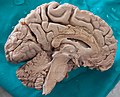 Human Brain Dissected
 -
 Cerebral Hemisphere Demonstration - Sanjoy Sanyal - Neuroscience Lab Fall 2013 - Parietooccipital sulcus


Ad. Transform your health with W8MD Weight Loss, Sleep & MedSpa

Tired of being overweight?
Special offer:
Budget GLP-1 weight loss medications
- Semaglutide starting from $29.99/week and up with insurance for visit of $59.99 and up per week self pay.
- Tirzepatide starting from $45.00/week and up (dose dependent) or $69.99/week and up self pay
✔ Same-week appointments, evenings & weekends
Learn more:
- GLP-1 weight loss clinic NYC
- W8MD's NYC medical weight loss
- W8MD Philadelphia GLP-1 shots
- Philadelphia GLP-1 injections
- Affordable GLP-1 shots NYC
|
WikiMD Medical Encyclopedia |
Medical Disclaimer: WikiMD is for informational purposes only and is not a substitute for professional medical advice. Content may be inaccurate or outdated and should not be used for diagnosis or treatment. Always consult your healthcare provider for medical decisions. Verify information with trusted sources such as CDC.gov and NIH.gov. By using this site, you agree that WikiMD is not liable for any outcomes related to its content. See full disclaimer.
Credits:Most images are courtesy of Wikimedia commons, and templates, categories Wikipedia, licensed under CC BY SA or similar.
Translate this page: - East Asian
中文,
日本,
한국어,
South Asian
हिन्दी,
தமிழ்,
తెలుగు,
Urdu,
ಕನ್ನಡ,
Southeast Asian
Indonesian,
Vietnamese,
Thai,
မြန်မာဘာသာ,
বাংলা
European
español,
Deutsch,
français,
Greek,
português do Brasil,
polski,
română,
русский,
Nederlands,
norsk,
svenska,
suomi,
Italian
Middle Eastern & African
عربى,
Turkish,
Persian,
Hebrew,
Afrikaans,
isiZulu,
Kiswahili,
Other
Bulgarian,
Hungarian,
Czech,
Swedish,
മലയാളം,
मराठी,
ਪੰਜਾਬੀ,
ગુજરાતી,
Portuguese,
Ukrainian
