Samarium
_chloride_hexahydrate.jpg)


Samarium is a chemical element with the symbol Sm and atomic number 62. It is a moderately hard silvery metal that slowly oxidizes in air. Being a typical member of the lanthanide series, samarium usually assumes the oxidation state +3. Compounds of samarium(II) are also known, most notably the monoxide SmO, monochalcogenides SmS, SmSe, and SmTe, as well as samarium(II) iodide. The last compound is a common reducing agent in chemical synthesis. Samarium has no significant biological role but is only slightly toxic.
Samarium was discovered spectroscopically in 1853 by Swiss chemist Jean Charles Galissard de Marignac in the mineral samarskite named after the Russian mining engineer Vasili Samarsky-Bykhovets, who facilitated the minerals' first analysis. However, it was not isolated in pure form until 1879 by Paul Émile Lecoq de Boisbaudran by the separation of samarium oxide. The element was named after the mineral samarskite from which it was isolated.
Properties[edit]
Physical[edit]
Samarium is a hard, brittle, lustrous metal that is relatively stable in air, slowly oxidizing to Sm2O3. It has a rhombohedral crystal structure. Samarium possesses typical metallic properties and is both ductile and malleable.
Chemical[edit]
Samarium's most common oxidation state is +3. It forms various compounds, such as oxides, sulfides, and halides. Samarium(III) oxide (Sm2O3) is a typical compound, used in specialized optical glasses to absorb infrared radiation. Samarium also forms compounds in the +2 oxidation state, such as samarium(II) iodide (SmI2), which is used as a reducing agent in organic synthesis.
Applications[edit]
Samarium has several applications, primarily due to its magnetic properties. The most significant use of samarium is in samarium-cobalt magnets, which are known for their high performance at elevated temperatures and are used in various high-end technological applications. These magnets are critical components in permanent magnet motors for electric vehicles, wind turbine generators, and headphones.
Another important application of samarium is in the field of nuclear reactors, where samarium is used as a neutron absorber. Samarium-149, a naturally occurring isotope, has a high cross-section for neutron capture and is used in control rods to regulate the reactor's neutron flux.
Samarium is also used in the manufacturing of certain catalysts and in the glass industry, where it serves as a colorant and helps absorb infrared radiation. In medicine, samarium-153 is used as a radiopharmaceutical for pain relief in patients with bone cancer, taking advantage of its ability to target and kill cancer cells while minimizing damage to healthy cells.
Occurrence and Production[edit]
Samarium is not found free in nature but is contained in many minerals, including monazite and bastnäsite, which are commercial sources of rare earth elements. The extraction and purification of samarium from these minerals involve complex metallurgical processes, typically starting with acid leaching, followed by solvent extraction and ion exchange techniques.
Isotopes[edit]
Samarium has several isotopes, with samarium-152 and samarium-154 being the most abundant. Samarium-149 is of particular interest for its use in nuclear reactors. The isotopes of samarium range in atomic weight from 144 to 154.
Health and Safety[edit]
While samarium is only slightly toxic, it should be handled with care, as with all chemicals and metals. The dust and compounds of samarium can be hazardous if ingested or inhaled, and appropriate safety precautions should be taken to avoid exposure.

This chemical element related article is a stub. You can help WikiMD by expanding it.
-
 Samarium(III) chloride hexahydrate
 -
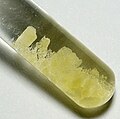 Samarium sulfate
 -
 153Sm-lexidronam structure
 -
 Lecoq de Boisbaudran
 -
 Samarskite
 -
 Samarium iodide
Ad. Transform your health with W8MD Weight Loss, Sleep & MedSpa

Tired of being overweight?
Special offer:
Budget GLP-1 weight loss medications
- Semaglutide starting from $29.99/week and up with insurance for visit of $59.99 and up per week self pay.
- Tirzepatide starting from $45.00/week and up (dose dependent) or $69.99/week and up self pay
✔ Same-week appointments, evenings & weekends
Learn more:
- GLP-1 weight loss clinic NYC
- W8MD's NYC medical weight loss
- W8MD Philadelphia GLP-1 shots
- Philadelphia GLP-1 injections
- Affordable GLP-1 shots NYC
|
WikiMD Medical Encyclopedia |
Medical Disclaimer: WikiMD is for informational purposes only and is not a substitute for professional medical advice. Content may be inaccurate or outdated and should not be used for diagnosis or treatment. Always consult your healthcare provider for medical decisions. Verify information with trusted sources such as CDC.gov and NIH.gov. By using this site, you agree that WikiMD is not liable for any outcomes related to its content. See full disclaimer.
Credits:Most images are courtesy of Wikimedia commons, and templates, categories Wikipedia, licensed under CC BY SA or similar.
Translate this page: - East Asian
中文,
日本,
한국어,
South Asian
हिन्दी,
தமிழ்,
తెలుగు,
Urdu,
ಕನ್ನಡ,
Southeast Asian
Indonesian,
Vietnamese,
Thai,
မြန်မာဘာသာ,
বাংলা
European
español,
Deutsch,
français,
Greek,
português do Brasil,
polski,
română,
русский,
Nederlands,
norsk,
svenska,
suomi,
Italian
Middle Eastern & African
عربى,
Turkish,
Persian,
Hebrew,
Afrikaans,
isiZulu,
Kiswahili,
Other
Bulgarian,
Hungarian,
Czech,
Swedish,
മലയാളം,
मराठी,
ਪੰਜਾਬੀ,
ગુજરાતી,
Portuguese,
Ukrainian
