Shark attack
Shark attacks refer to incidents of humans being attacked by sharks. Although relatively rare, with approximately 80 unprovoked attacks reported globally each year, the phenomenon often receives significant attention and perpetuates a widespread fear of sharks. This fear is frequently exacerbated by historic events of serial attacks, such as the Jersey Shore shark attacks of 1916, and sensationalized through horror fiction and film portrayals, like the renowned 'Jaws' series.
Frequency and Species Involved
Of the more than 489 shark species known to exist, only a fraction pose any significant threat to humans. The great white shark, tiger shark, and bull shark are the three species responsible for double-digit numbers of fatal, unprovoked attacks on humans. The oceanic whitetip shark is suspected to have caused numerous fatalities, particularly among shipwreck survivors, but these instances often go unrecorded and hence are not reflected in the official statistics.
Nature of Attacks
Shark attacks can be classified as provoked or unprovoked. Unprovoked attacks are initiated by the shark without any human provocation. Provoked attacks, on the other hand, occur when a human touches, teases, feeds, or otherwise disturbs a shark, prompting a defensive response.
Prevention and Response
There are several strategies to reduce the risk of shark attacks, such as avoiding swimming alone, staying close to shore, and refraining from entering the water if bleeding or if sharks are known to be present. Should a shark attack occur, fighting back by hitting the shark in the eyes or gills is often recommended, as these are sensitive areas. Medical attention should be sought immediately following a shark attack to manage trauma and prevent infection.
Public Perception and Conservation Efforts
Despite the rarity of shark attacks, public perception is often skewed towards viewing sharks as dangerous predators. This perception can have negative implications for shark conservation efforts, as these creatures play a critical role in maintaining marine ecosystem health. There is a growing need for education and awareness about the crucial role of sharks and the relative rarity of shark attacks to promote coexistence and conservation.
References
<references/>
See Also
 | |
|---|---|
 |
 |
-
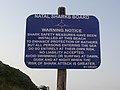 Shark warning sign at Salt Rock, South Africa
 -
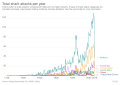 Total shark attacks per year
 -
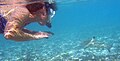 Snorkeler with blacktip reef shark
 -
 Watson and the Shark
 -
 White shark
 -
 Scarface tiger shark
 -
 Bull shark in Beqa, Fiji
 -
 Coogee Beach
 -
Protecting people from shark attacks
-
 Signs warning of shark attacks at Boa Viagem Beach, Recife, Brazil


Ad. Transform your life with W8MD's Budget GLP-1 injections from $49.99


W8MD offers a medical weight loss program to lose weight in Philadelphia. Our physician-supervised medical weight loss provides:
- Weight loss injections in NYC (generic and brand names):
- Zepbound / Mounjaro, Wegovy / Ozempic, Saxenda
- Most insurances accepted or discounted self-pay rates. We will obtain insurance prior authorizations if needed.
- Generic GLP1 weight loss injections from $49.99 for the starting dose of Semaglutide and $65.00 for Tirzepatide.
- Also offer prescription weight loss medications including Phentermine, Qsymia, Diethylpropion, Contrave etc.
NYC weight loss doctor appointmentsNYC weight loss doctor appointments
Start your NYC weight loss journey today at our NYC medical weight loss and Philadelphia medical weight loss clinics.
- Call 718-946-5500 to lose weight in NYC or for medical weight loss in Philadelphia 215-676-2334.
- Tags:NYC medical weight loss, Philadelphia lose weight Zepbound NYC, Budget GLP1 weight loss injections, Wegovy Philadelphia, Wegovy NYC, Philadelphia medical weight loss, Brookly weight loss and Wegovy NYC


|
WikiMD's Wellness Encyclopedia |
| Let Food Be Thy Medicine Medicine Thy Food - Hippocrates |
Medical Disclaimer: WikiMD is not a substitute for professional medical advice. The information on WikiMD is provided as an information resource only, may be incorrect, outdated or misleading, and is not to be used or relied on for any diagnostic or treatment purposes. Please consult your health care provider before making any healthcare decisions or for guidance about a specific medical condition. WikiMD expressly disclaims responsibility, and shall have no liability, for any damages, loss, injury, or liability whatsoever suffered as a result of your reliance on the information contained in this site. By visiting this site you agree to the foregoing terms and conditions, which may from time to time be changed or supplemented by WikiMD. If you do not agree to the foregoing terms and conditions, you should not enter or use this site. See full disclaimer.
Credits:Most images are courtesy of Wikimedia commons, and templates, categories Wikipedia, licensed under CC BY SA or similar.
Translate this page: - East Asian
中文,
日本,
한국어,
South Asian
हिन्दी,
தமிழ்,
తెలుగు,
Urdu,
ಕನ್ನಡ,
Southeast Asian
Indonesian,
Vietnamese,
Thai,
မြန်မာဘာသာ,
বাংলা
European
español,
Deutsch,
français,
Greek,
português do Brasil,
polski,
română,
русский,
Nederlands,
norsk,
svenska,
suomi,
Italian
Middle Eastern & African
عربى,
Turkish,
Persian,
Hebrew,
Afrikaans,
isiZulu,
Kiswahili,
Other
Bulgarian,
Hungarian,
Czech,
Swedish,
മലയാളം,
मराठी,
ਪੰਜਾਬੀ,
ગુજરાતી,
Portuguese,
Ukrainian
