Antigen presentation
-
 Antigen presentation
 -
 MHC Class I processing
 -
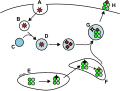 MHC Class II


Antigen Presentation[edit]
Antigen presentation is a crucial immunological process that involves the display of antigens on the surface of certain cells, known as antigen-presenting cells (APCs), to be recognized by T cells. This process is essential for the activation of the adaptive immune response.
Overview[edit]
Antigen presentation is a key step in the immune response, bridging the innate and adaptive immune systems. It involves the processing of antigens and their presentation on the cell surface in association with major histocompatibility complex (MHC) molecules. There are two main pathways of antigen presentation: the endogenous pathway and the exogenous pathway.
Endogenous Pathway[edit]
The endogenous pathway is responsible for presenting intracellular antigens, typically derived from viral infections or tumor cells. Proteins within the cell are degraded into peptides by the proteasome. These peptides are then transported into the endoplasmic reticulum by the transporter associated with antigen processing (TAP). Within the endoplasmic reticulum, peptides bind to MHC class I molecules. The peptide-MHC class I complexes are then transported to the cell surface, where they can be recognized by CD8+ T cells.
Exogenous Pathway[edit]
The exogenous pathway involves the presentation of extracellular antigens that have been internalized by the cell. These antigens are taken up by phagocytosis or endocytosis and are processed in endosomes or lysosomes. The resulting peptides are loaded onto MHC class II molecules within these vesicles. The peptide-MHC class II complexes are then transported to the cell surface for recognition by CD4+ T cells.
Antigen-Presenting Cells[edit]
Antigen-presenting cells are specialized cells that are capable of processing and presenting antigens to T cells. The main types of APCs include dendritic cells, macrophages, and B cells. Dendritic cells are considered the most potent APCs and are primarily responsible for initiating T cell responses.
Role in Immune Response[edit]
Antigen presentation is critical for the activation of T cells, which are essential for the adaptive immune response. CD8+ T cells, also known as cytotoxic T lymphocytes, are activated by antigens presented on MHC class I molecules and are responsible for killing infected or cancerous cells. CD4+ T cells, or helper T cells, are activated by antigens presented on MHC class II molecules and help orchestrate the immune response by activating other immune cells, including B cells and macrophages.
Related Pages[edit]
- Major histocompatibility complex
- T cell receptor
- Adaptive immune system
- Dendritic cell
- Macrophage
- B cell
| Immunology | ||||||||||
|---|---|---|---|---|---|---|---|---|---|---|
This immunology-related article is a stub.
|
Ad. Transform your health with W8MD Weight Loss, Sleep & MedSpa

Tired of being overweight?
Special offer:
Budget GLP-1 weight loss medications
- Semaglutide starting from $29.99/week and up with insurance for visit of $59.99 and up per week self pay.
- Tirzepatide starting from $45.00/week and up (dose dependent) or $69.99/week and up self pay
✔ Same-week appointments, evenings & weekends
Learn more:
- GLP-1 weight loss clinic NYC
- W8MD's NYC medical weight loss
- W8MD Philadelphia GLP-1 shots
- Philadelphia GLP-1 injections
- Affordable GLP-1 shots NYC
|
WikiMD Medical Encyclopedia |
Medical Disclaimer: WikiMD is for informational purposes only and is not a substitute for professional medical advice. Content may be inaccurate or outdated and should not be used for diagnosis or treatment. Always consult your healthcare provider for medical decisions. Verify information with trusted sources such as CDC.gov and NIH.gov. By using this site, you agree that WikiMD is not liable for any outcomes related to its content. See full disclaimer.
Credits:Most images are courtesy of Wikimedia commons, and templates, categories Wikipedia, licensed under CC BY SA or similar.
Translate this page: - East Asian
中文,
日本,
한국어,
South Asian
हिन्दी,
தமிழ்,
తెలుగు,
Urdu,
ಕನ್ನಡ,
Southeast Asian
Indonesian,
Vietnamese,
Thai,
မြန်မာဘာသာ,
বাংলা
European
español,
Deutsch,
français,
Greek,
português do Brasil,
polski,
română,
русский,
Nederlands,
norsk,
svenska,
suomi,
Italian
Middle Eastern & African
عربى,
Turkish,
Persian,
Hebrew,
Afrikaans,
isiZulu,
Kiswahili,
Other
Bulgarian,
Hungarian,
Czech,
Swedish,
മലയാളം,
मराठी,
ਪੰਜਾਬੀ,
ગુજરાતી,
Portuguese,
Ukrainian
