Typical pulmonary carcinoid tumour
Typical pulmonary carcinoid tumour
-
 Lung carcinoid - high magnification
 -
 Peripheral typical carcinoid tumor - CT scan
 -
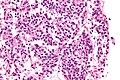 Lung carcinoid - very high magnification
 -
 Typical carcinoid tumor of the lung, prominent rosettes

.jpg)


Typical Pulmonary Carcinoid Tumour
A typical pulmonary carcinoid tumour is a type of neuroendocrine tumour that arises in the lungs. These tumours are generally considered to be low-grade malignancies and are part of the spectrum of lung cancer. They are distinct from atypical carcinoid tumours, which have a higher potential for aggressive behavior.
Pathophysiology
Typical pulmonary carcinoid tumours originate from neuroendocrine cells in the bronchial epithelium. These cells are part of the diffuse neuroendocrine system and have the ability to produce various hormones and neuropeptides. The exact cause of these tumours is not well understood, but they are thought to arise from genetic mutations that lead to uncontrolled cell growth.
Clinical Presentation
Patients with typical pulmonary carcinoid tumours may present with a variety of symptoms, depending on the size and location of the tumour. Common symptoms include:
- Cough
- Hemoptysis (coughing up blood)
- Wheezing
- Dyspnea (shortness of breath)
- Chest pain
Some patients may be asymptomatic, and the tumour is discovered incidentally on imaging studies performed for other reasons.
Diagnosis
The diagnosis of a typical pulmonary carcinoid tumour is typically made through a combination of imaging studies and histological examination.
- Imaging: Chest X-ray and CT scan of the chest are commonly used to identify the presence of a mass in the lungs.
- Biopsy: A bronchoscopy with biopsy or a CT-guided needle biopsy may be performed to obtain tissue for histological analysis.
- Histology: Under the microscope, typical carcinoid tumours are characterized by uniform cells with moderate cytoplasm and round to oval nuclei. They have a low mitotic rate and lack necrosis, distinguishing them from atypical carcinoid tumours.
Treatment
The primary treatment for typical pulmonary carcinoid tumours is surgical resection. The type of surgery depends on the size and location of the tumour and may include:
In cases where surgery is not feasible, other treatments such as radiotherapy or chemotherapy may be considered, although these are less effective for typical carcinoid tumours.
Prognosis
The prognosis for patients with typical pulmonary carcinoid tumours is generally favorable, with a high 5-year survival rate. These tumours tend to grow slowly and have a low potential for metastasis compared to other types of lung cancer.
Related Pages
| Lung cancer | ||||||||||
|---|---|---|---|---|---|---|---|---|---|---|
This Lung cancer related article is a stub.
|
Ad. Transform your health with W8MD Weight Loss, Sleep & MedSpa

Tired of being overweight?
Get started with evidence based, physician-supervised
affordable GLP-1 weight loss injections
Now available in New York City and Philadelphia:
- Semaglutide starting from $59.99/week and up
- Tirzepatide starting from $69.99/week and up (dose dependent)
✔ Evidence-based medical weight loss ✔ Insurance-friendly visits available ✔ Same-week appointments, evenings & weekends
Learn more:
Start your transformation today with W8MD weight loss centers.
|
WikiMD Medical Encyclopedia |
Medical Disclaimer: WikiMD is for informational purposes only and is not a substitute for professional medical advice. Content may be inaccurate or outdated and should not be used for diagnosis or treatment. Always consult your healthcare provider for medical decisions. Verify information with trusted sources such as CDC.gov and NIH.gov. By using this site, you agree that WikiMD is not liable for any outcomes related to its content. See full disclaimer.
Credits:Most images are courtesy of Wikimedia commons, and templates, categories Wikipedia, licensed under CC BY SA or similar.
Translate this page: - East Asian
中文,
日本,
한국어,
South Asian
हिन्दी,
தமிழ்,
తెలుగు,
Urdu,
ಕನ್ನಡ,
Southeast Asian
Indonesian,
Vietnamese,
Thai,
မြန်မာဘာသာ,
বাংলা
European
español,
Deutsch,
français,
Greek,
português do Brasil,
polski,
română,
русский,
Nederlands,
norsk,
svenska,
suomi,
Italian
Middle Eastern & African
عربى,
Turkish,
Persian,
Hebrew,
Afrikaans,
isiZulu,
Kiswahili,
Other
Bulgarian,
Hungarian,
Czech,
Swedish,
മലയാളം,
मराठी,
ਪੰਜਾਬੀ,
ગુજરાતી,
Portuguese,
Ukrainian
