Aortic valve repair
-
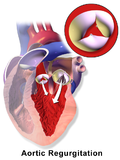 Aortic regurgitation illustration
 -
 Aortic valve preoperative
 -
 Aortic valve postoperative

Aortic Valve Repair[edit]
Aortic valve repair is a surgical procedure aimed at correcting dysfunctions of the aortic valve, which is one of the four main valves in the heart. This procedure is typically performed to treat conditions such as aortic regurgitation or aortic stenosis, where the valve does not function properly, leading to compromised blood flow from the heart to the rest of the body.
Indications[edit]
Aortic valve repair is indicated in patients with:
- Aortic regurgitation: A condition where the aortic valve does not close properly, causing blood to flow backward into the left ventricle.
- Aortic stenosis: A narrowing of the aortic valve opening, which restricts blood flow from the left ventricle to the aorta.
- Congenital heart defects: Such as a bicuspid aortic valve, where the valve has only two leaflets instead of the normal three.
Surgical Techniques[edit]
Aortic valve repair can be performed using various techniques, depending on the underlying pathology:
- Leaflet repair: Involves reshaping or trimming the valve leaflets to ensure proper closure.
- Annuloplasty: A ring-like device is used to reshape or reinforce the valve annulus, the ring-like structure that supports the valve leaflets.
- Commissurotomy: Used primarily for aortic stenosis, this technique involves cutting the fused commissures to widen the valve opening.
- Decalcification: Removal of calcium deposits from the valve leaflets to improve their flexibility and function.
Advantages and Disadvantages[edit]
Aortic valve repair offers several advantages over aortic valve replacement:
- Preservation of native valve: Retaining the patient's own valve can lead to better long-term outcomes and fewer complications.
- Avoidance of anticoagulation therapy: Unlike mechanical valve replacements, repaired valves typically do not require lifelong anticoagulation therapy.
- Reduced risk of infection: There is a lower risk of endocarditis compared to prosthetic valves.
However, aortic valve repair may not be suitable for all patients, particularly those with severely damaged or calcified valves.
Postoperative Care[edit]
After aortic valve repair, patients typically require close monitoring in a cardiac intensive care unit. Postoperative care includes:
- Monitoring for complications: Such as bleeding, infection, or arrhythmias.
- Echocardiography: To assess valve function and ensure successful repair.
- Rehabilitation: Cardiac rehabilitation programs to aid recovery and improve cardiovascular health.
Prognosis[edit]
The prognosis after aortic valve repair is generally favorable, with many patients experiencing significant improvement in symptoms and quality of life. Long-term outcomes depend on the underlying condition, the success of the repair, and the presence of any comorbidities.
Related Pages[edit]
Ad. Transform your health with W8MD Weight Loss, Sleep & MedSpa

Tired of being overweight?
Special offer:
Budget GLP-1 weight loss medications
- Semaglutide starting from $29.99/week and up with insurance for visit of $59.99 and up per week self pay.
- Tirzepatide starting from $45.00/week and up (dose dependent) or $69.99/week and up self pay
✔ Same-week appointments, evenings & weekends
Learn more:
- GLP-1 weight loss clinic NYC
- W8MD's NYC medical weight loss
- W8MD Philadelphia GLP-1 shots
- Philadelphia GLP-1 injections
- Affordable GLP-1 shots NYC
|
WikiMD Medical Encyclopedia |
Medical Disclaimer: WikiMD is for informational purposes only and is not a substitute for professional medical advice. Content may be inaccurate or outdated and should not be used for diagnosis or treatment. Always consult your healthcare provider for medical decisions. Verify information with trusted sources such as CDC.gov and NIH.gov. By using this site, you agree that WikiMD is not liable for any outcomes related to its content. See full disclaimer.
Credits:Most images are courtesy of Wikimedia commons, and templates, categories Wikipedia, licensed under CC BY SA or similar.
Translate this page: - East Asian
中文,
日本,
한국어,
South Asian
हिन्दी,
தமிழ்,
తెలుగు,
Urdu,
ಕನ್ನಡ,
Southeast Asian
Indonesian,
Vietnamese,
Thai,
မြန်မာဘာသာ,
বাংলা
European
español,
Deutsch,
français,
Greek,
português do Brasil,
polski,
română,
русский,
Nederlands,
norsk,
svenska,
suomi,
Italian
Middle Eastern & African
عربى,
Turkish,
Persian,
Hebrew,
Afrikaans,
isiZulu,
Kiswahili,
Other
Bulgarian,
Hungarian,
Czech,
Swedish,
മലയാളം,
मराठी,
ਪੰਜਾਬੀ,
ગુજરાતી,
Portuguese,
Ukrainian
