Apple scab
-
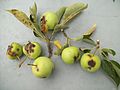 Apple fruits with scab
 -
 Apple scab on leaves
 -
 Apple scab under scanning electron microscope


Apple Scab[edit]
Apple scab is a fungal disease that affects apple trees and is caused by the pathogen Venturia inaequalis. It is one of the most common and economically significant diseases of apple trees worldwide. The disease primarily affects the leaves and fruit of the apple tree, leading to reduced fruit quality and yield.
Symptoms[edit]
The symptoms of apple scab are most noticeable on the leaves and fruit of the apple tree. On leaves, the disease manifests as olive-green to brown spots that are roughly circular and have a velvety texture. As the disease progresses, these spots may coalesce, causing the leaves to become distorted and eventually fall off the tree prematurely.
On the fruit, apple scab appears as dark, sunken lesions that can crack and deform the fruit. These lesions are often surrounded by a corky, raised margin. In severe cases, the fruit may become misshapen and unmarketable.
Life Cycle[edit]
The life cycle of Venturia inaequalis involves both sexual and asexual stages. The fungus overwinters in fallen leaves and fruit on the ground. In the spring, as temperatures rise and moisture increases, the fungus produces ascospores, which are released into the air and infect new leaves and fruit.
Once the initial infection occurs, the fungus produces conidia, which are asexual spores that can cause secondary infections throughout the growing season. These secondary infections can rapidly spread the disease, especially in wet and humid conditions.
Management[edit]
Managing apple scab involves a combination of cultural practices, resistant cultivars, and chemical controls. Cultural practices include removing and destroying fallen leaves and fruit to reduce the source of overwintering inoculum. Pruning to improve air circulation can also help reduce the humidity levels that favor the disease.
The use of fungicides is a common method for controlling apple scab, especially in commercial orchards. Fungicides are typically applied during the early stages of leaf and fruit development to prevent initial infections. It is important to follow a fungicide rotation program to prevent the development of fungicide-resistant strains of the pathogen.
Breeding and planting resistant apple cultivars is another effective strategy for managing apple scab. Some apple varieties have been developed with genetic resistance to Venturia inaequalis, reducing the need for chemical controls.
Related Pages[edit]
Ad. Transform your health with W8MD Weight Loss, Sleep & MedSpa

Tired of being overweight?
Special offer:
Budget GLP-1 weight loss medications
- Semaglutide starting from $29.99/week and up with insurance for visit of $59.99 and up per week self pay.
- Tirzepatide starting from $45.00/week and up (dose dependent) or $69.99/week and up self pay
✔ Same-week appointments, evenings & weekends
Learn more:
- GLP-1 weight loss clinic NYC
- W8MD's NYC medical weight loss
- W8MD Philadelphia GLP-1 shots
- Philadelphia GLP-1 injections
- Affordable GLP-1 shots NYC
|
WikiMD Medical Encyclopedia |
Medical Disclaimer: WikiMD is for informational purposes only and is not a substitute for professional medical advice. Content may be inaccurate or outdated and should not be used for diagnosis or treatment. Always consult your healthcare provider for medical decisions. Verify information with trusted sources such as CDC.gov and NIH.gov. By using this site, you agree that WikiMD is not liable for any outcomes related to its content. See full disclaimer.
Credits:Most images are courtesy of Wikimedia commons, and templates, categories Wikipedia, licensed under CC BY SA or similar.
Translate this page: - East Asian
中文,
日本,
한국어,
South Asian
हिन्दी,
தமிழ்,
తెలుగు,
Urdu,
ಕನ್ನಡ,
Southeast Asian
Indonesian,
Vietnamese,
Thai,
မြန်မာဘာသာ,
বাংলা
European
español,
Deutsch,
français,
Greek,
português do Brasil,
polski,
română,
русский,
Nederlands,
norsk,
svenska,
suomi,
Italian
Middle Eastern & African
عربى,
Turkish,
Persian,
Hebrew,
Afrikaans,
isiZulu,
Kiswahili,
Other
Bulgarian,
Hungarian,
Czech,
Swedish,
മലയാളം,
मराठी,
ਪੰਜਾਬੀ,
ગુજરાતી,
Portuguese,
Ukrainian
