Acer saccharum
Acer saccharum[edit]
.jpg)
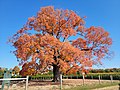
Acer saccharum, commonly known as the sugar maple, is a species of maple native to the hardwood forests of eastern Canada and the northeastern United States. It is best known for its bright fall foliage and for being the primary source of maple syrup.
Description[edit]
The sugar maple is a large, deciduous tree that can grow to heights of 25–35 meters (82–115 feet) and a trunk diameter of up to 1 meter (3.3 feet). The leaves are palmate, with five lobes, and are typically 8–15 cm (3.1–5.9 inches) long and equally wide. In autumn, the leaves turn vibrant shades of yellow, orange, and red.

The bark of the sugar maple is gray and smooth when young, becoming furrowed and rough with age. The tree produces small, greenish-yellow flowers in early spring, which are followed by paired winged seeds known as samaras.
Habitat and Distribution[edit]
Acer saccharum is found in a variety of forest types, often in association with other hardwoods such as American beech and yellow birch. It prefers well-drained, fertile soils and is commonly found in upland areas. The species is distributed across eastern North America, from Nova Scotia to Georgia and west to Minnesota.
Ecological Importance[edit]
The sugar maple plays a crucial role in its ecosystem, providing habitat and food for numerous species. Its leaves decompose to enrich the soil, and its seeds are a food source for small mammals and birds. The tree's dense canopy offers shade and shelter for various wildlife.
Economic Importance[edit]

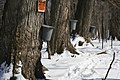
Acer saccharum is economically significant due to its role in the production of maple syrup. The sap is collected in early spring and boiled down to produce syrup. The wood of the sugar maple is also highly valued for its hardness and is used in furniture, flooring, and musical instruments.
Conservation[edit]
While the sugar maple is not currently considered threatened, it faces challenges from climate change, habitat loss, and pests such as the Asian longhorned beetle. Conservation efforts focus on maintaining healthy forest ecosystems and monitoring the impacts of environmental changes.
Gallery[edit]
-
 Maple and birch trees
 -
 Trunk base of a sugar maple
 -
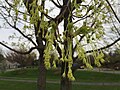 Sugar maple flowers
 -
 Sugar maple seeds
 -
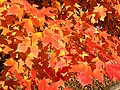 Autumn foliage
 -
 Autumn leaves
 -
 Illuminated sugar maple
 -
 Sugar maple in autumn


_crop.jpg)


Related pages[edit]
-
 Acer saccharum
 -
Acer saccharum
-
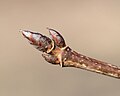 Acer saccharum
 -
Acer saccharum
-
Acer saccharum
-
Acer saccharum
-
Acer saccharum
-
Acer saccharum
-
 Acer saccharum
 -
Acer saccharum
-
Acer saccharum
-
 Acer saccharum
.jpg)
Ad. Transform your life with W8MD's
GLP-1 weight loss injections special from $29.99 with insurance
|
WikiMD Medical Encyclopedia |
Medical Disclaimer: WikiMD is for informational purposes only and is not a substitute for professional medical advice. Content may be inaccurate or outdated and should not be used for diagnosis or treatment. Always consult your healthcare provider for medical decisions. Verify information with trusted sources such as CDC.gov and NIH.gov. By using this site, you agree that WikiMD is not liable for any outcomes related to its content. See full disclaimer.
Credits:Most images are courtesy of Wikimedia commons, and templates, categories Wikipedia, licensed under CC BY SA or similar.
Translate this page: - East Asian
中文,
日本,
한국어,
South Asian
हिन्दी,
தமிழ்,
తెలుగు,
Urdu,
ಕನ್ನಡ,
Southeast Asian
Indonesian,
Vietnamese,
Thai,
မြန်မာဘာသာ,
বাংলা
European
español,
Deutsch,
français,
Greek,
português do Brasil,
polski,
română,
русский,
Nederlands,
norsk,
svenska,
suomi,
Italian
Middle Eastern & African
عربى,
Turkish,
Persian,
Hebrew,
Afrikaans,
isiZulu,
Kiswahili,
Other
Bulgarian,
Hungarian,
Czech,
Swedish,
മലയാളം,
मराठी,
ਪੰਜਾਬੀ,
ગુજરાતી,
Portuguese,
Ukrainian
