Skeletal formula
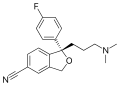
Skeletal formula, also known as a line-angle formula or stick figure diagram, is a type of molecular notation designed to represent the molecular structure of a chemical compound with the help of lines and symbols. It is widely used in organic chemistry for its simplicity and efficiency in conveying structural information. The skeletal formula is particularly useful for organic compounds, where the carbon atoms and their hydrogen atom connections are implied rather than explicitly drawn, making complex molecules easier to visualize and understand.
Overview[edit]
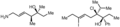
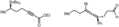
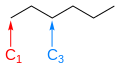
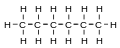
In a skeletal formula, carbon atoms are represented by the ends of lines or the junctions between lines and are not usually labeled with the letter "C". Hydrogen atoms attached to carbon are not shown, with the understanding that carbon atoms make four bonds in most organic compounds. Atoms other than carbon and hydrogen (such as oxygen, nitrogen, sulfur, etc.) are represented by their elemental symbols and are known as heteroatoms. These heteroatoms and any hydrogen atoms connected to them are usually drawn explicitly.
History[edit]
The use of skeletal formulas in organic chemistry can be traced back to the early 20th century when chemists sought more efficient ways to represent complex organic molecules. The development of this notation system simplified the drawing of molecules and facilitated the understanding of their structure and reactivity.
Advantages[edit]
The primary advantage of the skeletal formula is its ability to simplify complex organic molecules, making it easier for chemists to visualize and communicate molecular structures. This notation system is particularly beneficial in the field of organic synthesis, where chemists deal with molecules that can be quite large and complex.
How to Read[edit]
To read a skeletal formula, one must understand that each vertex (where lines meet) and line end represents a carbon atom with sufficient hydrogen atoms to complete its four bonds. Heteroatoms are drawn explicitly and are connected to carbon or other heteroatoms by lines representing bonds. Double or triple bonds between atoms are shown by drawing two or three lines, respectively.
Applications[edit]
Skeletal formulas are extensively used in organic chemistry, including in the areas of drug design, synthetic chemistry, and chemical biology. They are essential tools for chemists to share ideas, design experiments, and predict the behavior of organic compounds.
Limitations[edit]
While skeletal formulas are highly useful for organic compounds, they may not be as effective for inorganic compounds, where the assumption of carbon and hydrogen atoms does not apply. Additionally, the notation may not adequately represent the three-dimensional structure of molecules, which can be crucial for understanding reactivity and physical properties.
See Also[edit]

-
 Skeletal_formula
 -
 Skeletal_formula
 -
 Skeletal_formula
 -
 Skeletal_formula
 -
 Skeletal_formula
 -
 Skeletal_formula
 -
 Skeletal_formula
 -
 Skeletal_formula
 -
 Skeletal_formula
 -
 Skeletal_formula
 -
 Skeletal_formula
 -
 Skeletal_formula


Ad. Transform your health with W8MD Weight Loss, Sleep & MedSpa

Tired of being overweight?
Special offer:
Budget GLP-1 weight loss medications
- Semaglutide starting from $29.99/week and up with insurance for visit of $59.99 and up per week self pay.
- Tirzepatide starting from $45.00/week and up (dose dependent) or $69.99/week and up self pay
✔ Same-week appointments, evenings & weekends
Learn more:
- GLP-1 weight loss clinic NYC
- W8MD's NYC medical weight loss
- W8MD Philadelphia GLP-1 shots
- Philadelphia GLP-1 injections
- Affordable GLP-1 shots NYC
|
WikiMD Medical Encyclopedia |
Medical Disclaimer: WikiMD is for informational purposes only and is not a substitute for professional medical advice. Content may be inaccurate or outdated and should not be used for diagnosis or treatment. Always consult your healthcare provider for medical decisions. Verify information with trusted sources such as CDC.gov and NIH.gov. By using this site, you agree that WikiMD is not liable for any outcomes related to its content. See full disclaimer.
Credits:Most images are courtesy of Wikimedia commons, and templates, categories Wikipedia, licensed under CC BY SA or similar.
Translate this page: - East Asian
中文,
日本,
한국어,
South Asian
हिन्दी,
தமிழ்,
తెలుగు,
Urdu,
ಕನ್ನಡ,
Southeast Asian
Indonesian,
Vietnamese,
Thai,
မြန်မာဘာသာ,
বাংলা
European
español,
Deutsch,
français,
Greek,
português do Brasil,
polski,
română,
русский,
Nederlands,
norsk,
svenska,
suomi,
Italian
Middle Eastern & African
عربى,
Turkish,
Persian,
Hebrew,
Afrikaans,
isiZulu,
Kiswahili,
Other
Bulgarian,
Hungarian,
Czech,
Swedish,
മലയാളം,
मराठी,
ਪੰਜਾਬੀ,
ગુજરાતી,
Portuguese,
Ukrainian
