Facial Angles (Camper)
Facial Angles (Camper) refer to a concept in anthropology, anatomy, and art history that involves measuring the angles of the face to determine certain characteristics or to distinguish between different human groups. The concept was introduced by Pieter Camper, an 18th-century Dutch anatomist, physician, and mathematician, who believed that these angles could be used to measure the aesthetic beauty or to categorize different racial groups, a practice now considered scientifically invalid and ethically problematic.
Overview[edit]
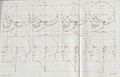
Facial angles are determined by drawing lines from specific anatomical points on the face and measuring the angle these lines create. The most common of these is the angle formed by drawing one line from the forehead to the most prominent part of the upper jaw and another line from the nose to the ear. Camper's original intention was to use these angles to compare the facial features of different animals and humans to study the differences between species. However, his work was later misinterpreted and misused in the development of scientific racism.
Measurement and Significance[edit]
The measurement of Camper's facial angle involves two key points on the face: the Prosthion (the most forward point on the upper jaw) and the Inion (the most prominent point on the back of the skull). By drawing a line from the prosthion to the inion and another from the forehead to the upper jaw, the angle created is Camper's facial angle. In humans, this angle typically ranges between 65 to 85 degrees.
Historically, Camper suggested that a larger angle was indicative of beauty, associating higher angles with classical Greek sculpture and European features, while smaller angles were attributed to non-European peoples. This concept was later expanded upon by other scientists and used to justify racial hierarchies, a use that has been thoroughly discredited.
Criticism and Contemporary Views[edit]
The use of facial angles as a means to categorize races has been criticized for its lack of scientific basis and its role in promoting racial stereotypes and discrimination. Modern anthropology and genetics have shown that the concept of race is not biologically grounded in the way Camper and his contemporaries believed. Today, the study of facial angles is more relevant in the fields of forensic anthropology, orthodontics, and craniofacial surgery for practical purposes such as identifying unknown remains, diagnosing facial abnormalities, and planning surgical interventions, rather than for classifying human diversity.
In Art and Aesthetics[edit]
In art history and aesthetics, the concept of facial angles is sometimes referenced in the study of classical art and sculpture, where the ideals of beauty were often represented by certain geometric proportions. However, the interpretation and appreciation of beauty in art are now understood to be culturally relative and not bound to specific measurements or angles.
See Also[edit]

-
 Facial Angles (Camper)
 -
 Facial Angles (Camper)
 -
 Facial Angles (Camper)
 -
 Facial Angles (Camper)
 -
 Facial Angles (Camper)
 -
 Facial Angles (Camper)
 -
 Facial Angles (Camper)


Ad. Transform your health with W8MD Weight Loss, Sleep & MedSpa

Tired of being overweight?
Get started with evidence based, physician-supervised
affordable GLP-1 weight loss injections
Now available in New York City and Philadelphia:
- Semaglutide starting from $59.99/week and up
- Tirzepatide starting from $69.99/week and up (dose dependent)
✔ Evidence-based medical weight loss ✔ Insurance-friendly visits available ✔ Same-week appointments, evenings & weekends
Learn more:
Start your transformation today with W8MD weight loss centers.
|
WikiMD Medical Encyclopedia |
Medical Disclaimer: WikiMD is for informational purposes only and is not a substitute for professional medical advice. Content may be inaccurate or outdated and should not be used for diagnosis or treatment. Always consult your healthcare provider for medical decisions. Verify information with trusted sources such as CDC.gov and NIH.gov. By using this site, you agree that WikiMD is not liable for any outcomes related to its content. See full disclaimer.
Credits:Most images are courtesy of Wikimedia commons, and templates, categories Wikipedia, licensed under CC BY SA or similar.
Translate this page: - East Asian
中文,
日本,
한국어,
South Asian
हिन्दी,
தமிழ்,
తెలుగు,
Urdu,
ಕನ್ನಡ,
Southeast Asian
Indonesian,
Vietnamese,
Thai,
မြန်မာဘာသာ,
বাংলা
European
español,
Deutsch,
français,
Greek,
português do Brasil,
polski,
română,
русский,
Nederlands,
norsk,
svenska,
suomi,
Italian
Middle Eastern & African
عربى,
Turkish,
Persian,
Hebrew,
Afrikaans,
isiZulu,
Kiswahili,
Other
Bulgarian,
Hungarian,
Czech,
Swedish,
മലയാളം,
मराठी,
ਪੰਜਾਬੀ,
ગુજરાતી,
Portuguese,
Ukrainian
