Pancreatic duct
Pancreatic Duct
The Pancreatic Duct or Duct of Wirsung is a duct joining the pancreas to the common bile duct to supply pancreatic juice provided from the exocrine pancreas, which aids in digestion.
Structure[edit]
The pancreatic duct runs the length of the pancreas and is formed by the union of smaller ducts within the organ. It begins at the tail end of the pancreas, and runs towards the head, where it usually merges with the common bile duct, and enters the duodenum at the major duodenal papilla. The pancreatic juice it carries is a clear, colorless liquid consisting of water, salts, and enzymes, which aid in digestion.
Clinical Significance[edit]
The pancreatic duct can be the site of several medical conditions. Pancreatitis is inflammation of the pancreas, which can be acute or chronic, and is often associated with blockage of the pancreatic duct. Pancreatic cancer can also occur in the pancreatic duct, and is often diagnosed late due to the deep location of the pancreas. Pancreatic duct stones are another condition that can occur, often as a result of chronic pancreatitis.
See Also[edit]
References[edit]
<references />
External Links[edit]
- Pancreatic Duct at the US National Library of Medicine Medical Subject Headings (MeSH)
 | |
|---|---|
 |
 |
-
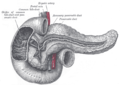 Pancreatic duct anatomy
 -
 Illustration of the pancreas
 -
 Formation of an accessory pancreatic duct
 -
 ERCP showing pancreatic duct
 -
 Digestive system showing bile duct
 -
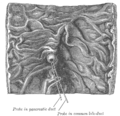 Pancreatic duct anatomy
 -
 Pancreatic duct anatomy
 -
 Pancreatic duct anatomy
 -
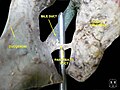 Pancreatic duct anatomy
 -
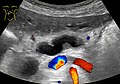 Ultrasonography of dilated pancreatic duct


Ad. Transform your life with W8MD's
GLP-1 weight loss injections special from $29.99 with insurance
|
WikiMD Medical Encyclopedia |
Medical Disclaimer: WikiMD is for informational purposes only and is not a substitute for professional medical advice. Content may be inaccurate or outdated and should not be used for diagnosis or treatment. Always consult your healthcare provider for medical decisions. Verify information with trusted sources such as CDC.gov and NIH.gov. By using this site, you agree that WikiMD is not liable for any outcomes related to its content. See full disclaimer.
Credits:Most images are courtesy of Wikimedia commons, and templates, categories Wikipedia, licensed under CC BY SA or similar.
Translate this page: - East Asian
中文,
日本,
한국어,
South Asian
हिन्दी,
தமிழ்,
తెలుగు,
Urdu,
ಕನ್ನಡ,
Southeast Asian
Indonesian,
Vietnamese,
Thai,
မြန်မာဘာသာ,
বাংলা
European
español,
Deutsch,
français,
Greek,
português do Brasil,
polski,
română,
русский,
Nederlands,
norsk,
svenska,
suomi,
Italian
Middle Eastern & African
عربى,
Turkish,
Persian,
Hebrew,
Afrikaans,
isiZulu,
Kiswahili,
Other
Bulgarian,
Hungarian,
Czech,
Swedish,
മലയാളം,
मराठी,
ਪੰਜਾਬੀ,
ગુજરાતી,
Portuguese,
Ukrainian
