Primary motor cortex
Primary Motor Cortex
The Primary Motor Cortex (PMC), also known as M1, is a region in the brain that plays a key role in motor function. It is located in the posterior portion of the frontal lobe, just anterior to the central sulcus. The PMC is responsible for generating neural impulses that control the execution of movement.
Anatomy[edit]
The primary motor cortex is located in the precentral gyrus, and it is the main contributor to generating motor commands. It is bordered by the precentral sulcus anteriorly and the central sulcus posteriorly. The PMC is further divided into an anterior and posterior part. The anterior part is involved in planning and executing movements, while the posterior part is involved in controlling voluntary movements.
Function[edit]
The primary motor cortex is responsible for controlling voluntary movements. It does this by sending signals to the spinal cord, which then sends signals to the muscles. The PMC is organized somatotopically, meaning that specific parts of the PMC control specific parts of the body. This organization is often referred to as the motor homunculus.
Clinical significance[edit]
Damage to the primary motor cortex can result in a variety of motor deficits, including paralysis, apraxia, and motor aphasia. Additionally, conditions such as stroke or traumatic brain injury can also affect the function of the PMC.
Research[edit]
Research on the primary motor cortex has been extensive and has contributed to our understanding of motor control and neuroplasticity. Techniques such as transcranial magnetic stimulation have been used to study the function of the PMC.
See also[edit]

This article is a neuroscience stub. You can help WikiMD by expanding it!
-
 Primary motor cortex
 -
 Diagram of brain sensory and motor areas
 -
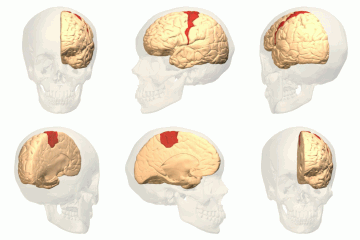 Animation of Brodmann area 4
 -
 Human motor map
 -
 Precentral sulcus
 -
 Central sulcus
 -
 Primary motor cortex


Ad. Transform your life with W8MD's
GLP-1 weight loss injections special from $29.99 with insurance
|
WikiMD Medical Encyclopedia |
Medical Disclaimer: WikiMD is for informational purposes only and is not a substitute for professional medical advice. Content may be inaccurate or outdated and should not be used for diagnosis or treatment. Always consult your healthcare provider for medical decisions. Verify information with trusted sources such as CDC.gov and NIH.gov. By using this site, you agree that WikiMD is not liable for any outcomes related to its content. See full disclaimer.
Credits:Most images are courtesy of Wikimedia commons, and templates, categories Wikipedia, licensed under CC BY SA or similar.
Translate this page: - East Asian
中文,
日本,
한국어,
South Asian
हिन्दी,
தமிழ்,
తెలుగు,
Urdu,
ಕನ್ನಡ,
Southeast Asian
Indonesian,
Vietnamese,
Thai,
မြန်မာဘာသာ,
বাংলা
European
español,
Deutsch,
français,
Greek,
português do Brasil,
polski,
română,
русский,
Nederlands,
norsk,
svenska,
suomi,
Italian
Middle Eastern & African
عربى,
Turkish,
Persian,
Hebrew,
Afrikaans,
isiZulu,
Kiswahili,
Other
Bulgarian,
Hungarian,
Czech,
Swedish,
മലയാളം,
मराठी,
ਪੰਜਾਬੀ,
ગુજરાતી,
Portuguese,
Ukrainian
