Bürgi–Dunitz angle
Bürgi–Dunitz angle refers to a specific geometric angle observed in the approach of a nucleophile to a carbonyl group during a chemical reaction. This concept is named after Hans-Beat Bürgi and Jack D. Dunitz who first described it in the 1970s through crystallographic studies. The Bürgi–Dunitz angle is crucial in understanding the stereochemistry of nucleophilic addition reactions to carbonyl compounds, which are fundamental in organic chemistry and biochemistry.
Overview[edit]
The Bürgi–Dunitz angle is typically observed to be around 107°. This angle is measured between the approaching nucleophile and the normal to the plane formed by the carbonyl carbon and its attached oxygen. The significance of this angle lies in its consistent observation across a wide range of nucleophilic addition reactions to carbonyl groups, indicating a preferred trajectory for nucleophilic attack.
Chemical Significance[edit]
In the context of chemical reactions, the Bürgi–Dunitz angle provides insights into the mechanism of nucleophilic addition to carbonyl groups. Understanding this angle helps chemists predict and control the stereochemical outcomes of reactions. For instance, in asymmetric synthesis, manipulating the approach of the nucleophile can lead to the preferential formation of one enantiomer over another, which is of paramount importance in the pharmaceutical industry.
Biological Relevance[edit]
The concept of the Bürgi–Dunitz angle also finds relevance in biochemistry, particularly in the study of enzyme-catalyzed reactions involving carbonyl groups. Enzymes are known to precisely control the geometry of substrate binding and reaction pathways, often utilizing the principles underlying the Bürgi–Dunitz angle to achieve high specificity and efficiency in catalysis.
Research and Applications[edit]
Research into the Bürgi–Dunitz angle continues to be a vibrant area of study, with applications ranging from the design of new synthetic methodologies to the development of drugs and biomaterials. Advances in computational chemistry and molecular modeling have further enhanced our understanding of this geometric phenomenon, allowing for the exploration of its implications in complex chemical and biological systems.
See Also[edit]
External Links[edit]

-
 Bürgi–Dunitz angle
 -
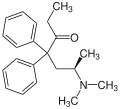 Levomethadone structure
 -
 Protopine structure
 -
 Protopine 3D structure


-
Bürgi–Dunitz angle
-
Levomethadone structure
-
Protopine structure
-
Protopine from crystal structure
-
 Bürgi–Dunitz angle 2D representation
 -
 Nucleophile HOMO and carbonyl LUMO overlap


Ad. Transform your health with W8MD Weight Loss, Sleep & MedSpa

Tired of being overweight?
Special offer:
Budget GLP-1 weight loss medications
- Semaglutide starting from $29.99/week and up with insurance for visit of $59.99 and up per week self pay.
- Tirzepatide starting from $45.00/week and up (dose dependent) or $69.99/week and up self pay
✔ Same-week appointments, evenings & weekends
Learn more:
- GLP-1 weight loss clinic NYC
- W8MD's NYC medical weight loss
- W8MD Philadelphia GLP-1 shots
- Philadelphia GLP-1 injections
- Affordable GLP-1 shots NYC
|
WikiMD Medical Encyclopedia |
Medical Disclaimer: WikiMD is for informational purposes only and is not a substitute for professional medical advice. Content may be inaccurate or outdated and should not be used for diagnosis or treatment. Always consult your healthcare provider for medical decisions. Verify information with trusted sources such as CDC.gov and NIH.gov. By using this site, you agree that WikiMD is not liable for any outcomes related to its content. See full disclaimer.
Credits:Most images are courtesy of Wikimedia commons, and templates, categories Wikipedia, licensed under CC BY SA or similar.
Translate this page: - East Asian
中文,
日本,
한국어,
South Asian
हिन्दी,
தமிழ்,
తెలుగు,
Urdu,
ಕನ್ನಡ,
Southeast Asian
Indonesian,
Vietnamese,
Thai,
မြန်မာဘာသာ,
বাংলা
European
español,
Deutsch,
français,
Greek,
português do Brasil,
polski,
română,
русский,
Nederlands,
norsk,
svenska,
suomi,
Italian
Middle Eastern & African
عربى,
Turkish,
Persian,
Hebrew,
Afrikaans,
isiZulu,
Kiswahili,
Other
Bulgarian,
Hungarian,
Czech,
Swedish,
മലയാളം,
मराठी,
ਪੰਜਾਬੀ,
ગુજરાતી,
Portuguese,
Ukrainian
