Facultative bipedalism
Facultative bipedalism is a form of locomotion, utilized by some animals, that allows for the ability to walk or run on two legs (bipedalism) when necessary, while normally moving in a quadrupedal (four-legged) manner. This adaptation is seen in various species, including some primates, rodents, and reptiles, allowing these animals to adapt to their environments or specific situations by switching between quadrupedalism and bipedalism. Facultative bipedalism is distinct from obligate bipedalism, where the organism is exclusively bipedal and has anatomy fully adapted for two-legged locomotion, such as in humans (Homo sapiens).
Evolutionary Significance[edit]
The evolutionary significance of facultative bipedalism lies in its role as a potential precursor to obligate bipedalism in the evolutionary history of primates, particularly in the lineage leading to humans. It is hypothesized that facultative bipedalism may have offered evolutionary advantages, such as the ability to reach food sources in trees or to see over tall grasses, which could have led to the development of obligate bipedalism in some species. The study of facultative bipedalism in extant animals, therefore, provides valuable insights into the evolutionary pathways that may have been taken by early hominins.
Anatomical and Physiological Aspects[edit]
Facultative bipedal animals exhibit certain anatomical and physiological traits that enable them to switch between bipedal and quadrupedal locomotion. These traits may include more flexible spines, stronger and more adaptable hind limbs, and changes in muscle distribution and coordination. The exact adaptations vary widely among different species, reflecting the diverse evolutionary pressures and ecological niches they occupy.
Examples[edit]
- Primates: Some primates, such as the chimpanzee (Pan troglodytes) and bonobo (Pan paniscus), exhibit facultative bipedalism, especially when carrying objects or in specific social or feeding contexts.
- Rodents: Certain rodents, like the agouti, can stand or walk on their hind legs to reach food or look out for predators.
- Reptiles: Some reptiles, such as the Australian water dragon (Intellagama lesueurii), are known to run bipedally when moving at high speeds or escaping predators.
Behavioral and Ecological Implications[edit]
The ability to switch between bipedal and quadrupedal locomotion has significant behavioral and ecological implications for facultative bipedal species. It can affect their foraging behavior, predator avoidance strategies, and social interactions. For example, bipedalism can allow animals to carry more food or offspring, to see over obstacles or tall vegetation, and to present certain social signals to other members of their species.
Research and Study[edit]
Research into facultative bipedalism involves a multidisciplinary approach, including the fields of comparative anatomy, physiology, ethology, and paleoanthropology. Studies often involve direct observation of extant species, comparative anatomical studies, and the examination of fossil records to infer locomotor behavior in extinct species.
Conclusion[edit]
Facultative bipedalism represents a fascinating aspect of animal locomotion and adaptation, offering insights into the complexity of evolutionary processes and the diversity of life. Its study helps to bridge the gap between quadrupedal and bipedal locomotion, shedding light on the evolutionary history of bipedalism in the animal kingdom, including the lineage leading to modern humans.

-
 Verreaux's Sifaka demonstrating facultative bipedalism
 -
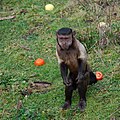 Capuchin monkey standing on two legs
 -
 Young chimpanzee walking bipedally
 -
 Bearded dragon lizard exhibiting facultative bipedalism
 -
 Gorgosaurus, an example of facultative bipedalism


.jpg)


Ad. Transform your life with W8MD's
GLP-1 weight loss injections special from $29.99 with insurance
|
WikiMD Medical Encyclopedia |
Medical Disclaimer: WikiMD is for informational purposes only and is not a substitute for professional medical advice. Content may be inaccurate or outdated and should not be used for diagnosis or treatment. Always consult your healthcare provider for medical decisions. Verify information with trusted sources such as CDC.gov and NIH.gov. By using this site, you agree that WikiMD is not liable for any outcomes related to its content. See full disclaimer.
Credits:Most images are courtesy of Wikimedia commons, and templates, categories Wikipedia, licensed under CC BY SA or similar.
Translate this page: - East Asian
中文,
日本,
한국어,
South Asian
हिन्दी,
தமிழ்,
తెలుగు,
Urdu,
ಕನ್ನಡ,
Southeast Asian
Indonesian,
Vietnamese,
Thai,
မြန်မာဘာသာ,
বাংলা
European
español,
Deutsch,
français,
Greek,
português do Brasil,
polski,
română,
русский,
Nederlands,
norsk,
svenska,
suomi,
Italian
Middle Eastern & African
عربى,
Turkish,
Persian,
Hebrew,
Afrikaans,
isiZulu,
Kiswahili,
Other
Bulgarian,
Hungarian,
Czech,
Swedish,
മലയാളം,
मराठी,
ਪੰਜਾਬੀ,
ગુજરાતી,
Portuguese,
Ukrainian
