Onchocerca volvulus
Onchocerca volvulus is a parasitic nematode (roundworm) that is the primary cause of Onchocerciasis, also known as river blindness, a disease that affects millions of people primarily in sub-Saharan Africa. The parasite is transmitted to humans through the bite of an infected blackfly of the genus Simulium. Once inside the human body, the larvae develop into adult worms, which create nodules under the skin and produce millions of microfilariae. These microfilariae can migrate to the skin and eyes, leading to severe inflammation, visual impairment, and ultimately blindness.
Life Cycle[edit]
The life cycle of Onchocerca volvulus involves two hosts: humans and blackflies. When an infected blackfly bites a human, it introduces the larval stage of the worm, known as microfilariae, into the bloodstream. These larvae migrate to various parts of the body and mature into adult worms, which form nodules under the skin. Adult female worms can produce thousands of new microfilariae daily, which can then be ingested by blackflies when they bite an infected individual, continuing the cycle.
Symptoms and Diagnosis[edit]
The primary symptoms of Onchocerca volvulus infection include severe itching, dermatitis, and skin depigmentation, known as "leopard skin." The most serious complication arises when microfilariae migrate to the eyes, causing inflammation and scarring that can lead to blindness. Diagnosis is typically made through the identification of microfilariae in skin snip biopsies or by detecting antibodies against the parasite in blood samples.
Treatment and Control[edit]
Treatment of Onchocerca volvulus infection primarily involves the administration of the drug Ivermectin, which kills the microfilariae but not the adult worms. Repeated doses are necessary to control the symptoms and prevent blindness. Efforts to control the spread of the disease focus on reducing the population of the blackfly vector through insecticide spraying and the mass distribution of ivermectin in endemic areas.
Epidemiology[edit]
Onchocerca volvulus is endemic in 31 countries in sub-Saharan Africa, with isolated cases reported in Yemen and the Americas. The World Health Organization estimates that approximately 17 million people are infected with the parasite, with more than 270,000 cases of blindness caused by the disease.
Prevention[edit]
Prevention of Onchocerca volvulus infection is challenging due to the wide distribution of the blackfly vector. Community-wide administration of ivermectin has been the most effective strategy for reducing the incidence of onchocerciasis. Personal protective measures, such as wearing long sleeves and using insect repellent, can also reduce the risk of blackfly bites.
 | This medical article is a stub. You can help WikiMD by expanding the page. |
-
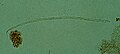 Microfilariae of Onchocerca volvulus
 -
 Onchocerca volvulus adult worms
 -
 Life Cycle of Onchocerca volvulus
 -
 Geographical distribution of Onchocerciasis
 -
 Onchocerca volvulus


Medical Disclaimer: WikiMD is for informational purposes only and is not a substitute for professional medical advice. Content may be inaccurate or outdated and should not be used for diagnosis or treatment. Always consult your healthcare provider for medical decisions. Verify information with trusted sources such as CDC.gov and NIH.gov. By using this site, you agree that WikiMD is not liable for any outcomes related to its content. See full disclaimer.
Credits:Most images are courtesy of Wikimedia commons, and templates, categories Wikipedia, licensed under CC BY SA or similar.
Translate this page: - East Asian
中文,
日本,
한국어,
South Asian
हिन्दी,
தமிழ்,
తెలుగు,
Urdu,
ಕನ್ನಡ,
Southeast Asian
Indonesian,
Vietnamese,
Thai,
မြန်မာဘာသာ,
বাংলা
European
español,
Deutsch,
français,
Greek,
português do Brasil,
polski,
română,
русский,
Nederlands,
norsk,
svenska,
suomi,
Italian
Middle Eastern & African
عربى,
Turkish,
Persian,
Hebrew,
Afrikaans,
isiZulu,
Kiswahili,
Other
Bulgarian,
Hungarian,
Czech,
Swedish,
മലയാളം,
मराठी,
ਪੰਜਾਬੀ,
ગુજરાતી,
Portuguese,
Ukrainian
