Ouchterlony double immunodiffusion
Ouchterlony double immunodiffusion (also known as double gel diffusion or passive double immunodiffusion) is a laboratory technique used in immunology to detect or quantify antigens and antibodies in a sample. This method relies on the principle of immunodiffusion, where antibodies and antigens diffuse through a semi-solid medium, typically agarose, and form precipitin lines where they meet and bind to each other. The technique was developed by Örjan Ouchterlony in 1948, making it one of the earliest tools for studying antigen-antibody reactions.
Principle[edit]
In Ouchterlony double immunodiffusion, both antigen and antibody are allowed to diffuse into the agarose gel from separate wells. As they diffuse towards each other, antigen-antibody complexes form when the antigen encounters its specific antibody. This interaction results in the formation of a visible precipitin line in the gel. The pattern and intensity of these lines can be analyzed to determine the presence, identity, and relative concentration of antigens or antibodies in the samples.
Procedure[edit]
The procedure for Ouchterlony double immunodiffusion involves several steps:
- A gel is prepared by pouring melted agarose into a petri dish or a similar flat surface.
- Once the gel has solidified, wells are punched into the agar at specific distances from each other.
- The antigen and antibody solutions are then carefully pipetted into their respective wells.
- The petri dish is incubated at room temperature or in a humid chamber to allow diffusion to occur.
- After sufficient time has passed for diffusion and precipitin line formation, the results are analyzed.
Interpretation of Results[edit]
The interpretation of results in Ouchterlony double immunodiffusion is based on the pattern of precipitin lines formed:
- A single line between a well containing antigen and a well containing antibody indicates a specific reaction.
- The absence of a line suggests that there is no antigen-antibody reaction, possibly due to the absence of the antigen or antibody in the samples.
- Crossed lines indicate the presence of more than one antigen in the sample reacting with the antibody.
- The convergence of lines from different antigen wells towards a single antibody well suggests that the antigens are similar or share common epitopes.
Applications[edit]
Ouchterlony double immunodiffusion has been widely used for:
- Identifying unknown antigens or antibodies.
- Comparing antigenic similarities and differences among various samples.
- Estimating the concentration of antigens or antibodies through semi-quantitative analysis.
- Diagnosing diseases by detecting specific antigens or antibodies in patient samples.
Advantages and Limitations[edit]
Advantages:
- Simple and inexpensive technique.
- Requires no special equipment.
- Can visually demonstrate antigen-antibody reactions.
Limitations:
- Less sensitive compared to other immunological methods such as ELISA or Western blot.
- Quantitative analysis is only semi-quantitative and less precise.
- Time-consuming, as diffusion can take several hours to days.
See Also[edit]

This article is a immunology stub. You can help WikiMD by expanding it!
-
 Ouchterlony double immunodiffusion
 -
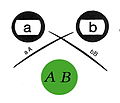 Antigen identification pattern
 -
 No identification pattern
 -
 Non-identification pattern


Ad. Transform your life with W8MD's
GLP-1 weight loss injections special from $29.99 with insurance
|
WikiMD Medical Encyclopedia |
Medical Disclaimer: WikiMD is for informational purposes only and is not a substitute for professional medical advice. Content may be inaccurate or outdated and should not be used for diagnosis or treatment. Always consult your healthcare provider for medical decisions. Verify information with trusted sources such as CDC.gov and NIH.gov. By using this site, you agree that WikiMD is not liable for any outcomes related to its content. See full disclaimer.
Credits:Most images are courtesy of Wikimedia commons, and templates, categories Wikipedia, licensed under CC BY SA or similar.
Translate this page: - East Asian
中文,
日本,
한국어,
South Asian
हिन्दी,
தமிழ்,
తెలుగు,
Urdu,
ಕನ್ನಡ,
Southeast Asian
Indonesian,
Vietnamese,
Thai,
မြန်မာဘာသာ,
বাংলা
European
español,
Deutsch,
français,
Greek,
português do Brasil,
polski,
română,
русский,
Nederlands,
norsk,
svenska,
suomi,
Italian
Middle Eastern & African
عربى,
Turkish,
Persian,
Hebrew,
Afrikaans,
isiZulu,
Kiswahili,
Other
Bulgarian,
Hungarian,
Czech,
Swedish,
മലയാളം,
मराठी,
ਪੰਜਾਬੀ,
ગુજરાતી,
Portuguese,
Ukrainian
