Non-coding RNA
Non-coding RNA (ncRNA) is a type of RNA that does not encode a protein, but has functions of its own. Non-coding RNAs play various roles in the cell, including regulation of gene expression, organization of chromosome structure, and alteration of protein activity.
Types of Non-coding RNA[edit]
There are several types of non-coding RNAs, each with distinct functions. These include:
- MicroRNA (miRNA): These are small non-coding RNAs that regulate gene expression at the post-transcriptional level. They bind to messenger RNA (mRNA) molecules and prevent them from being translated into proteins.
- Small interfering RNA (siRNA): These are double-stranded non-coding RNAs that interfere with the expression of specific genes. They do this by degrading mRNA after it has been transcribed.
- Long non-coding RNA (lncRNA): These are longer RNA molecules that regulate gene expression at various levels, including transcription and post-transcriptional processing.
- Ribosomal RNA (rRNA): This is a component of the ribosome, the cellular machinery that translates mRNA into protein.
- Transfer RNA (tRNA): This is involved in the process of translation, carrying amino acids to the ribosome to be added to the growing protein chain.
Function of Non-coding RNA[edit]
Non-coding RNAs have a wide range of functions in the cell. They are involved in the regulation of gene expression, the modification of proteins, the organization of chromosomes, and many other processes. Some non-coding RNAs, such as miRNAs and siRNAs, regulate gene expression by binding to mRNA molecules and preventing them from being translated into proteins. Others, such as lncRNAs, can interact with proteins and other molecules to regulate gene expression at the level of transcription.
Role in Disease[edit]
Alterations in the function of non-coding RNAs have been implicated in a number of diseases, including cancer, neurodegenerative diseases, and cardiovascular diseases. For example, changes in the expression levels of certain miRNAs have been associated with the development and progression of cancer. Similarly, mutations in lncRNAs have been linked to neurodegenerative diseases such as Alzheimer's disease and Parkinson's disease.
See Also[edit]
This RNA related article is a stub. You can help WikiMD by expanding it.
-
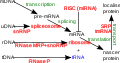 Non-coding RNA
 -
 Yeast tRNA-Phe structure
 -
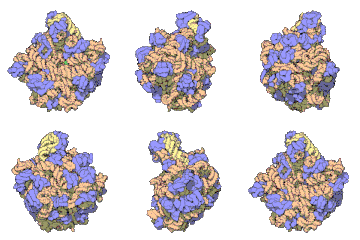 Large ribosomal subunit
 -
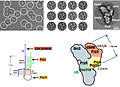 Yeast tri-snRNP complex
 -
 YRNA bound to Ro60


Ad. Transform your health with W8MD Weight Loss, Sleep & MedSpa

Tired of being overweight?
Special offer:
Budget GLP-1 weight loss medications
- Semaglutide starting from $29.99/week and up with insurance for visit of $59.99 and up per week self pay.
- Tirzepatide starting from $45.00/week and up (dose dependent) or $69.99/week and up self pay
✔ Same-week appointments, evenings & weekends
Learn more:
- GLP-1 weight loss clinic NYC
- W8MD's NYC medical weight loss
- W8MD Philadelphia GLP-1 shots
- Philadelphia GLP-1 injections
- Affordable GLP-1 shots NYC
|
WikiMD Medical Encyclopedia |
Medical Disclaimer: WikiMD is for informational purposes only and is not a substitute for professional medical advice. Content may be inaccurate or outdated and should not be used for diagnosis or treatment. Always consult your healthcare provider for medical decisions. Verify information with trusted sources such as CDC.gov and NIH.gov. By using this site, you agree that WikiMD is not liable for any outcomes related to its content. See full disclaimer.
Credits:Most images are courtesy of Wikimedia commons, and templates, categories Wikipedia, licensed under CC BY SA or similar.
Translate this page: - East Asian
中文,
日本,
한국어,
South Asian
हिन्दी,
தமிழ்,
తెలుగు,
Urdu,
ಕನ್ನಡ,
Southeast Asian
Indonesian,
Vietnamese,
Thai,
မြန်မာဘာသာ,
বাংলা
European
español,
Deutsch,
français,
Greek,
português do Brasil,
polski,
română,
русский,
Nederlands,
norsk,
svenska,
suomi,
Italian
Middle Eastern & African
عربى,
Turkish,
Persian,
Hebrew,
Afrikaans,
isiZulu,
Kiswahili,
Other
Bulgarian,
Hungarian,
Czech,
Swedish,
മലയാളം,
मराठी,
ਪੰਜਾਬੀ,
ગુજરાતી,
Portuguese,
Ukrainian
