Leydig cell
Leydig cells, also known as interstitial cells of Leydig, are found adjacent to the seminiferous tubules in the testicle. They produce testosterone in the presence of luteinizing hormone (LH). Leydig cells are polyhedral in shape, display a large nucleus, an eosinophilic cytoplasm and numerous lipid-filled vesicles.
Function[edit]
Leydig cells generate testosterone in response to luteinizing hormone (LH). Testosterone is responsible for the primary and secondary sexual characteristics in males. It also promotes sexual drive and regulates the production of sperm.
Development[edit]
Leydig cells develop in the testes during embryogenesis. They originate from the mesenchyme of the gonadal ridge. The development of Leydig cells is influenced by several hormones, including LH and human chorionic gonadotropin (hCG).
Clinical significance[edit]
Abnormalities in Leydig cells can lead to several medical conditions. For instance, Leydig cell hypoplasia is a rare form of male pseudohermaphroditism. Leydig cell tumors, although rare, can also occur and may lead to endocrine disorders.
See also[edit]
References[edit]
<references />
 | This medical article is a stub. You can help WikiMD by expanding the page. |
-
 Leydig cell tumour
 -
 Diagram of the male reproductive system
 -
 Leydig cell tumour
 -
Leydig cell tumour
-
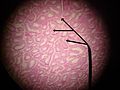 Leydig cells


Medical Disclaimer: WikiMD is for informational purposes only and is not a substitute for professional medical advice. Content may be inaccurate or outdated and should not be used for diagnosis or treatment. Always consult your healthcare provider for medical decisions. Verify information with trusted sources such as CDC.gov and NIH.gov. By using this site, you agree that WikiMD is not liable for any outcomes related to its content. See full disclaimer.
Credits:Most images are courtesy of Wikimedia commons, and templates, categories Wikipedia, licensed under CC BY SA or similar.
Translate this page: - East Asian
中文,
日本,
한국어,
South Asian
हिन्दी,
தமிழ்,
తెలుగు,
Urdu,
ಕನ್ನಡ,
Southeast Asian
Indonesian,
Vietnamese,
Thai,
မြန်မာဘာသာ,
বাংলা
European
español,
Deutsch,
français,
Greek,
português do Brasil,
polski,
română,
русский,
Nederlands,
norsk,
svenska,
suomi,
Italian
Middle Eastern & African
عربى,
Turkish,
Persian,
Hebrew,
Afrikaans,
isiZulu,
Kiswahili,
Other
Bulgarian,
Hungarian,
Czech,
Swedish,
മലയാളം,
मराठी,
ਪੰਜਾਬੀ,
ગુજરાતી,
Portuguese,
Ukrainian
