Francisco de Orellana
Francisco de Orellana (1511 – November 1546) was a Spanish explorer and conquistador, best known for his extensive exploration of the Amazon River. Orellana is credited with being the first European to navigate the entire length of the Amazon, providing invaluable insights into the geography, biodiversity, and indigenous cultures of the region.
Early Life[edit]
Francisco de Orellana was born in 1511 in Trujillo, Spain. Little is known about his early life before he embarked on his career as an explorer. In his youth, he moved to the New World, seeking fortune and adventure among the Spanish expeditions.
Expedition to the Amazon[edit]
In 1541, Orellana joined a Spanish expedition led by Gonzalo Pizarro, the younger half-brother of the famous conquistador Francisco Pizarro. The expedition's goal was to explore the South American interior in search of the mythical "El Dorado," a city rumored to be filled with gold. The journey began in Quito, Ecuador, and as the expedition progressed, it faced immense hardships, including lack of food, hostile indigenous tribes, and difficult terrain.
Due to these challenges, Gonzalo Pizarro sent Orellana downriver with a small contingent to find food and help. Orellana and his men constructed a boat and, upon reaching the confluence of the Napo and Amazon Rivers, decided to continue their journey down the Amazon in search of a way back to Spain. This decision marked the beginning of Orellana's historic voyage.
Throughout his journey, Orellana encountered numerous indigenous tribes, some of which engaged in trade while others were hostile. One significant encounter was with a tribe of warrior women, which reminded Orellana of the ancient Amazons of Greek mythology, leading him to name the river "Amazon."
Legacy[edit]
Orellana's expedition down the Amazon River was a remarkable feat of exploration. He provided the first detailed European accounts of the Amazon rainforest, its rivers, indigenous peoples, and wildlife. His journey significantly contributed to European knowledge of South America's interior and the Amazon River, which remains one of the most vital natural resources in the world.
Orellana's voyage also opened the door for further exploration and exploitation of the Amazon by Europeans, which had profound and often devastating effects on the indigenous populations and ecosystems of the region.
Death[edit]
Francisco de Orellana died in November 1546 on the banks of the Amazon River during a second expedition to establish Spanish settlements in the area. His exact cause of death is unknown, but it is believed to have been due to illness or the harsh conditions of the journey.
In Popular Culture[edit]
Orellana's adventures have been romanticized in literature and film, often portrayed as a daring explorer who ventured into the unknown. His encounter with the warrior women has particularly captured the imagination, contributing to the myth of the Amazon women.
See Also[edit]

-
 Francisco de Orellana
 -
 Francisco de Orellana
 -
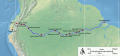 Francisco de Orellana's Amazon River voyage (1541-1542)
 -
 Voyage of Francisco de Orellana Map by António Pereira, 1546
 -
 Monumento a Francisco de Orellana, Guápulo


.svg)


Ad. Transform your health with W8MD Weight Loss, Sleep & MedSpa

Tired of being overweight?
Special offer:
Budget GLP-1 weight loss medications
- Semaglutide starting from $29.99/week and up with insurance for visit of $59.99 and up per week self pay.
- Tirzepatide starting from $45.00/week and up (dose dependent) or $69.99/week and up self pay
✔ Same-week appointments, evenings & weekends
Learn more:
- GLP-1 weight loss clinic NYC
- W8MD's NYC medical weight loss
- W8MD Philadelphia GLP-1 shots
- Philadelphia GLP-1 injections
- Affordable GLP-1 shots NYC
|
WikiMD Medical Encyclopedia |
Medical Disclaimer: WikiMD is for informational purposes only and is not a substitute for professional medical advice. Content may be inaccurate or outdated and should not be used for diagnosis or treatment. Always consult your healthcare provider for medical decisions. Verify information with trusted sources such as CDC.gov and NIH.gov. By using this site, you agree that WikiMD is not liable for any outcomes related to its content. See full disclaimer.
Credits:Most images are courtesy of Wikimedia commons, and templates, categories Wikipedia, licensed under CC BY SA or similar.
Translate this page: - East Asian
中文,
日本,
한국어,
South Asian
हिन्दी,
தமிழ்,
తెలుగు,
Urdu,
ಕನ್ನಡ,
Southeast Asian
Indonesian,
Vietnamese,
Thai,
မြန်မာဘာသာ,
বাংলা
European
español,
Deutsch,
français,
Greek,
português do Brasil,
polski,
română,
русский,
Nederlands,
norsk,
svenska,
suomi,
Italian
Middle Eastern & African
عربى,
Turkish,
Persian,
Hebrew,
Afrikaans,
isiZulu,
Kiswahili,
Other
Bulgarian,
Hungarian,
Czech,
Swedish,
മലയാളം,
मराठी,
ਪੰਜਾਬੀ,
ગુજરાતી,
Portuguese,
Ukrainian
