Organoaluminium chemistry
Organoaluminium chemistry is the study of compounds containing bonds between carbon and aluminium. It is a subfield of organometallic chemistry and focuses on the properties, synthesis, and reactions of these compounds. Organoaluminium compounds play a crucial role in various industrial processes, especially in polymer production and organic synthesis.
Overview[edit]
Organoaluminium compounds are typically classified based on the number of carbon-aluminium bonds. The most common types include trialkylaluminiums (R3Al), dialkylaluminium hydrides (R2AlH), and alkylaluminium halides (R3Al2X3, where X is a halogen). These compounds are known for their reactivity and are widely used as catalysts, co-catalysts, or intermediates in organic reactions.
Synthesis[edit]
The synthesis of organoaluminium compounds can be achieved through several methods. One of the most common methods is the direct reaction of aluminium metal with alkenes or alkyl halides in the presence of hydrogen gas, a process known as hydroalumination. Another method involves the reaction of aluminium halides with Grignard reagents or organolithium compounds.
Properties[edit]
Organoaluminium compounds are generally highly reactive. They are sensitive to air and moisture, requiring special handling techniques such as the use of inert atmosphere conditions. Their reactivity is influenced by the nature of the alkyl groups attached to the aluminium and the presence of other ligands or substituents.
Applications[edit]
One of the most significant applications of organoaluminium chemistry is in the field of polymer science. Trialkylaluminium compounds, for example, are used as catalysts in the Ziegler-Natta polymerization to produce polyethylene and polypropylene. These materials have a wide range of applications, from packaging materials to automotive parts.
In organic synthesis, organoaluminium compounds are employed as reducing agents, Lewis acids, and components in various carbon-carbon bond-forming reactions. Their ability to activate electrophiles makes them valuable tools in the synthesis of complex organic molecules.
Safety[edit]
Handling organoaluminium compounds requires caution due to their reactivity towards air and moisture. Proper safety measures, including the use of glove boxes or inert gas techniques, are essential to prevent unwanted reactions that could lead to fires or explosions.
See Also[edit]

-
 DIBAL 3D structure
 -
 Trimethylaluminium 3D structure
 -
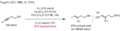 Carboalumination reaction


Ad. Transform your health with W8MD Weight Loss, Sleep & MedSpa

Tired of being overweight?
Special offer:
Budget GLP-1 weight loss medications
- Semaglutide starting from $29.99/week and up with insurance for visit of $59.99 and up per week self pay.
- Tirzepatide starting from $45.00/week and up (dose dependent) or $69.99/week and up self pay
✔ Same-week appointments, evenings & weekends
Learn more:
- GLP-1 weight loss clinic NYC
- W8MD's NYC medical weight loss
- W8MD Philadelphia GLP-1 shots
- Philadelphia GLP-1 injections
- Affordable GLP-1 shots NYC
|
WikiMD Medical Encyclopedia |
Medical Disclaimer: WikiMD is for informational purposes only and is not a substitute for professional medical advice. Content may be inaccurate or outdated and should not be used for diagnosis or treatment. Always consult your healthcare provider for medical decisions. Verify information with trusted sources such as CDC.gov and NIH.gov. By using this site, you agree that WikiMD is not liable for any outcomes related to its content. See full disclaimer.
Credits:Most images are courtesy of Wikimedia commons, and templates, categories Wikipedia, licensed under CC BY SA or similar.
Translate this page: - East Asian
中文,
日本,
한국어,
South Asian
हिन्दी,
தமிழ்,
తెలుగు,
Urdu,
ಕನ್ನಡ,
Southeast Asian
Indonesian,
Vietnamese,
Thai,
မြန်မာဘာသာ,
বাংলা
European
español,
Deutsch,
français,
Greek,
português do Brasil,
polski,
română,
русский,
Nederlands,
norsk,
svenska,
suomi,
Italian
Middle Eastern & African
عربى,
Turkish,
Persian,
Hebrew,
Afrikaans,
isiZulu,
Kiswahili,
Other
Bulgarian,
Hungarian,
Czech,
Swedish,
മലയാളം,
मराठी,
ਪੰਜਾਬੀ,
ગુજરાતી,
Portuguese,
Ukrainian
