Tasmanian giant crab
Tasmanian giant crab (Pseudocarcinus gigas) is a species of crab that inhabits the waters of southern Australia. It is one of the largest crabs in the world.
Description[edit]
The Tasmanian giant crab is notable for its size, with males reaching up to 16 kilograms in weight and a carapace width of up to 46 centimeters. Females are significantly smaller, typically weighing less than 2 kilograms. The crab's body is a deep, mottled red color, and it has a pair of large, powerful claws.
Distribution and habitat[edit]
The Tasmanian giant crab is found in the cold, deep waters of the Southern Ocean, off the coast of Tasmania, and also off the coast of Western Australia and South Australia. It typically inhabits depths of 140 to 270 meters, but has been found at depths of up to 820 meters.
Diet[edit]
The diet of the Tasmanian giant crab is largely scavenging in nature. It feeds on dead and decaying matter, including fish and other marine animals. It is also known to eat slow-moving species such as sea urchins, starfish, and mollusks.
Life cycle[edit]
The life cycle of the Tasmanian giant crab is not well understood. Females carry the eggs, which are fertilized by the male. The eggs are carried on the female's abdomen until they hatch into larvae. The larvae go through several stages of development before reaching maturity.
Commercial importance[edit]
The Tasmanian giant crab is commercially fished in Australia. It is considered a delicacy and is particularly popular in Asian markets. The fishery is carefully managed to ensure sustainability, with strict size and catch limits in place.
Conservation[edit]
While the Tasmanian giant crab is not currently considered endangered, it is vulnerable to overfishing due to its slow growth rate and late maturity. Conservation efforts are focused on sustainable fishing practices and habitat protection.
See also[edit]
.png)
This article is a crustacean-related stub. You can help WikiMD by expanding it!

-
 Tasmanian giant crab in its natural habitat
 -
 Illustration of a Tasmanian giant crab by J. J. Wild
 -
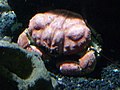 Close-up of a Tasmanian giant crab


Ad. Transform your health with W8MD Weight Loss, Sleep & MedSpa

Tired of being overweight?
Special offer:
Budget GLP-1 weight loss medications
- Semaglutide starting from $29.99/week and up with insurance for visit of $59.99 and up per week self pay.
- Tirzepatide starting from $45.00/week and up (dose dependent) or $69.99/week and up self pay
✔ Same-week appointments, evenings & weekends
Learn more:
- GLP-1 weight loss clinic NYC
- W8MD's NYC medical weight loss
- W8MD Philadelphia GLP-1 shots
- Philadelphia GLP-1 injections
- Affordable GLP-1 shots NYC
|
WikiMD Medical Encyclopedia |
Medical Disclaimer: WikiMD is for informational purposes only and is not a substitute for professional medical advice. Content may be inaccurate or outdated and should not be used for diagnosis or treatment. Always consult your healthcare provider for medical decisions. Verify information with trusted sources such as CDC.gov and NIH.gov. By using this site, you agree that WikiMD is not liable for any outcomes related to its content. See full disclaimer.
Credits:Most images are courtesy of Wikimedia commons, and templates, categories Wikipedia, licensed under CC BY SA or similar.
Translate this page: - East Asian
中文,
日本,
한국어,
South Asian
हिन्दी,
தமிழ்,
తెలుగు,
Urdu,
ಕನ್ನಡ,
Southeast Asian
Indonesian,
Vietnamese,
Thai,
မြန်မာဘာသာ,
বাংলা
European
español,
Deutsch,
français,
Greek,
português do Brasil,
polski,
română,
русский,
Nederlands,
norsk,
svenska,
suomi,
Italian
Middle Eastern & African
عربى,
Turkish,
Persian,
Hebrew,
Afrikaans,
isiZulu,
Kiswahili,
Other
Bulgarian,
Hungarian,
Czech,
Swedish,
മലയാളം,
मराठी,
ਪੰਜਾਬੀ,
ગુજરાતી,
Portuguese,
Ukrainian
