Kolbe–Schmitt reaction
Kolbe–Schmitt reaction or Kolbe process is a carboxylation chemical reaction that synthesizes salicylic acid and its derivatives. This reaction is named after the German chemists Hermann Kolbe and Rudolf Schmitt who developed the process in 1885. The Kolbe–Schmitt reaction proceeds by the nucleophilic addition of carbon dioxide to a phenoxide, which is formed from the deprotonation of a phenol. The reaction is significant in both organic chemistry and the pharmaceutical industry, particularly in the production of aspirin and other salicylate drugs.
Reaction Mechanism
The Kolbe–Schmitt reaction begins with the treatment of a phenol with a strong base, typically potassium hydroxide (KOH), resulting in the formation of a potassium phenoxide. This phenoxide then reacts with carbon dioxide under high pressure and temperature to form a potassium salicylate. Acidification of the potassium salicylate yields salicylic acid, a key precursor in the synthesis of aspirin and other pharmaceuticals.
The general reaction can be represented as follows:
Phenol + CO2 (high pressure, high temperature) → Salicylic acid
Applications
The primary application of the Kolbe–Schmitt reaction is in the pharmaceutical industry for the production of salicylic acid and its derivatives. Salicylic acid is a precursor to aspirin (acetylsalicylic acid), one of the most widely used medications for pain relief, fever reduction, and anti-inflammatory purposes. Additionally, salicylic acid derivatives produced through this reaction are used in the manufacture of dyes, fragrances, and preservatives.
Advantages and Limitations
One of the main advantages of the Kolbe–Schmitt reaction is its straightforward mechanism, which allows for the efficient production of salicylic acid and its derivatives. However, the reaction conditions—high pressure and temperature—can be considered a limitation as they require specialized equipment and can increase production costs. Furthermore, the reaction's specificity to phenols limits its applicability to a narrower range of substrates.
Environmental Considerations
The environmental impact of the Kolbe–Schmitt reaction is a topic of ongoing research. While the reaction itself does not produce significant toxic byproducts, the use of high pressure and temperature conditions raises concerns regarding energy consumption and the carbon footprint of the process. Efforts to develop more sustainable versions of the Kolbe–Schmitt reaction are focused on lowering the reaction conditions and finding greener alternatives for the reagents used.
See Also

-
 Mechanism of the Kolbe–Schmitt reaction
 -
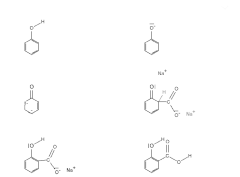 Animation of the Kolbe–Schmitt reaction


Ad. Transform your life with W8MD's Budget GLP-1 injections from $75


W8MD offers a medical weight loss program to lose weight in Philadelphia. Our physician-supervised medical weight loss provides:
- Weight loss injections in NYC (generic and brand names):
- Zepbound / Mounjaro, Wegovy / Ozempic, Saxenda
- Most insurances accepted or discounted self-pay rates. We will obtain insurance prior authorizations if needed.
- Generic GLP1 weight loss injections from $75 for the starting dose.
- Also offer prescription weight loss medications including Phentermine, Qsymia, Diethylpropion, Contrave etc.
NYC weight loss doctor appointmentsNYC weight loss doctor appointments
Start your NYC weight loss journey today at our NYC medical weight loss and Philadelphia medical weight loss clinics.
- Call 718-946-5500 to lose weight in NYC or for medical weight loss in Philadelphia 215-676-2334.
- Tags:NYC medical weight loss, Philadelphia lose weight Zepbound NYC, Budget GLP1 weight loss injections, Wegovy Philadelphia, Wegovy NYC, Philadelphia medical weight loss, Brookly weight loss and Wegovy NYC


|
WikiMD's Wellness Encyclopedia |
| Let Food Be Thy Medicine Medicine Thy Food - Hippocrates |
Medical Disclaimer: WikiMD is not a substitute for professional medical advice. The information on WikiMD is provided as an information resource only, may be incorrect, outdated or misleading, and is not to be used or relied on for any diagnostic or treatment purposes. Please consult your health care provider before making any healthcare decisions or for guidance about a specific medical condition. WikiMD expressly disclaims responsibility, and shall have no liability, for any damages, loss, injury, or liability whatsoever suffered as a result of your reliance on the information contained in this site. By visiting this site you agree to the foregoing terms and conditions, which may from time to time be changed or supplemented by WikiMD. If you do not agree to the foregoing terms and conditions, you should not enter or use this site. See full disclaimer.
Credits:Most images are courtesy of Wikimedia commons, and templates, categories Wikipedia, licensed under CC BY SA or similar.
Translate this page: - East Asian
中文,
日本,
한국어,
South Asian
हिन्दी,
தமிழ்,
తెలుగు,
Urdu,
ಕನ್ನಡ,
Southeast Asian
Indonesian,
Vietnamese,
Thai,
မြန်မာဘာသာ,
বাংলা
European
español,
Deutsch,
français,
Greek,
português do Brasil,
polski,
română,
русский,
Nederlands,
norsk,
svenska,
suomi,
Italian
Middle Eastern & African
عربى,
Turkish,
Persian,
Hebrew,
Afrikaans,
isiZulu,
Kiswahili,
Other
Bulgarian,
Hungarian,
Czech,
Swedish,
മലയാളം,
मराठी,
ਪੰਜਾਬੀ,
ગુજરાતી,
Portuguese,
Ukrainian
