Phosphatidylinositol
Phosphatidylinositol (abbreviated PI) is a class of lipids, specifically a phospholipid, which is an integral component of cell membranes in eukaryotic cells. It is composed of a glycerol backbone with two fatty acid chains, a phosphate group, and an inositol ring.
Structure and Synthesis[edit]
Phosphatidylinositol is synthesized in the endoplasmic reticulum from cytidine diphosphate-diacylglycerol (CDP-DAG) and inositol. The inositol ring can be phosphorylated by various kinases on the 3, 4, and 5 positions of the ring.
Function[edit]
Phosphatidylinositol plays a key role in several biological functions. It is a precursor for many second messengers that are important in transmitting signals from the cell surface to the cell interior. These include inositol trisphosphate (IP3) and diacylglycerol (DAG), which are produced by the action of phospholipase C (PLC) on phosphatidylinositol 4,5-bisphosphate (PIP2).
Phosphatidylinositol also plays a crucial role in protein trafficking by acting as a docking site for certain types of proteins. The phosphorylated forms of phosphatidylinositol, known as phosphoinositides, are located on the inner leaflet of the cell membrane and can bind to specific domains in proteins, targeting them to the membrane.
Clinical Significance[edit]
Alterations in phosphatidylinositol metabolism have been implicated in several diseases, including cancer, diabetes, and bipolar disorder. For example, mutations in the gene encoding phosphatidylinositol 4,5-bisphosphate 3-kinase (PIK3CA), which phosphorylates PIP2 to produce PIP3, have been found in many types of cancer.
See Also[edit]
References[edit]

-
 Structure of Phosphatidylinositol with components
 -
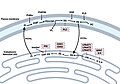 Phosphatidylinositol hydrolysis and synthesis


Ad. Transform your life with W8MD's
GLP-1 weight loss injections special from $29.99 with insurance
|
WikiMD Medical Encyclopedia |
Medical Disclaimer: WikiMD is for informational purposes only and is not a substitute for professional medical advice. Content may be inaccurate or outdated and should not be used for diagnosis or treatment. Always consult your healthcare provider for medical decisions. Verify information with trusted sources such as CDC.gov and NIH.gov. By using this site, you agree that WikiMD is not liable for any outcomes related to its content. See full disclaimer.
Credits:Most images are courtesy of Wikimedia commons, and templates, categories Wikipedia, licensed under CC BY SA or similar.
Translate this page: - East Asian
中文,
日本,
한국어,
South Asian
हिन्दी,
தமிழ்,
తెలుగు,
Urdu,
ಕನ್ನಡ,
Southeast Asian
Indonesian,
Vietnamese,
Thai,
မြန်မာဘာသာ,
বাংলা
European
español,
Deutsch,
français,
Greek,
português do Brasil,
polski,
română,
русский,
Nederlands,
norsk,
svenska,
suomi,
Italian
Middle Eastern & African
عربى,
Turkish,
Persian,
Hebrew,
Afrikaans,
isiZulu,
Kiswahili,
Other
Bulgarian,
Hungarian,
Czech,
Swedish,
മലയാളം,
मराठी,
ਪੰਜਾਬੀ,
ગુજરાતી,
Portuguese,
Ukrainian
