Gate control theory
Gate Control Theory is a significant concept in the field of neuroscience and pain management. It was proposed by Ronald Melzack and Patrick Wall in 1965 and has since revolutionized the understanding of how pain is perceived and processed by the central nervous system. The theory suggests that the perception of pain is not a direct result of activation of pain fiber transmissions to the brain, but rather, it is modulated by the interplay between different types of nerve fibers and neural mechanisms in the spinal cord.
Overview[edit]
The gate control theory posits that the spinal cord contains a neurological "gate" that either blocks pain signals or allows them to continue on to the brain. This gate does not physically exist but is a metaphor for how pain signals are processed and perceived. According to the theory, pain signals are transmitted by small-diameter nerve fibers and can be inhibited by the activity of larger-diameter fibers and by information coming from the brain.
Mechanism[edit]
The gate is located in the dorsal horn of the spinal cord and is influenced by the relative amount of activity in the large (non-nociceptive) and small (nociceptive) fibers. Non-nociceptive fibers are associated with touch, pressure, and vibration sensations, whereas nociceptive fibers transmit pain. When non-nociceptive fibers are more active, they close the gate, thereby inhibiting the sensation of pain. Conversely, when nociceptive fibers are more active, they open the gate, allowing pain signals to pass through to the brain.
The theory also emphasizes the role of the brain in pain perception. It suggests that signals descending from the brain can influence the gate mechanism, either facilitating or inhibiting pain perception. This explains how psychological factors, such as attention, emotions, and expectations, can affect pain experience.
Clinical Implications[edit]
The gate control theory has profound implications for pain management and treatment. It provides a theoretical basis for the effectiveness of non-pharmacological pain relief methods such as transcutaneous electrical nerve stimulation (TENS), acupuncture, and massage therapy. These methods are thought to work by activating non-nociceptive fibers, thus closing the gate to pain signals.
Furthermore, the theory supports the use of cognitive and behavioral strategies, such as cognitive-behavioral therapy (CBT) and mindfulness, in managing pain. By altering one's emotional and cognitive response to pain, these strategies can modulate the brain's influence on the gate mechanism, potentially reducing the perception of pain.
Criticism and Development[edit]
While the gate control theory has been influential, it has also faced criticism and undergone revisions. Critics argue that the theory oversimplifies the complex nature of pain processing. Subsequent research has expanded on the original model, incorporating new findings on the neurophysiological and molecular mechanisms of pain. Despite these criticisms, the gate control theory remains a cornerstone in the field of pain research, providing valuable insights into the multifaceted nature of pain perception and management.
Conclusion[edit]
The gate control theory of pain has significantly advanced our understanding of pain mechanisms and has led to the development of innovative approaches to pain management. By highlighting the role of the spinal cord and the brain in the pain processing system, it has paved the way for treatments that go beyond traditional pharmacological interventions, incorporating psychological and physical therapies to address the complex experience of pain.

-
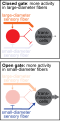 Gate Theory Circuit Mechanism
 -
 Gate control no A
 -
 Gate control A firing


Ad. Transform your health with W8MD Weight Loss, Sleep & MedSpa

Tired of being overweight?
Special offer:
Budget GLP-1 weight loss medications
- Semaglutide starting from $29.99/week and up with insurance for visit of $59.99 and up per week self pay.
- Tirzepatide starting from $45.00/week and up (dose dependent) or $69.99/week and up self pay
✔ Same-week appointments, evenings & weekends
Learn more:
- GLP-1 weight loss clinic NYC
- W8MD's NYC medical weight loss
- W8MD Philadelphia GLP-1 shots
- Philadelphia GLP-1 injections
- Affordable GLP-1 shots NYC
|
WikiMD Medical Encyclopedia |
Medical Disclaimer: WikiMD is for informational purposes only and is not a substitute for professional medical advice. Content may be inaccurate or outdated and should not be used for diagnosis or treatment. Always consult your healthcare provider for medical decisions. Verify information with trusted sources such as CDC.gov and NIH.gov. By using this site, you agree that WikiMD is not liable for any outcomes related to its content. See full disclaimer.
Credits:Most images are courtesy of Wikimedia commons, and templates, categories Wikipedia, licensed under CC BY SA or similar.
Translate this page: - East Asian
中文,
日本,
한국어,
South Asian
हिन्दी,
தமிழ்,
తెలుగు,
Urdu,
ಕನ್ನಡ,
Southeast Asian
Indonesian,
Vietnamese,
Thai,
မြန်မာဘာသာ,
বাংলা
European
español,
Deutsch,
français,
Greek,
português do Brasil,
polski,
română,
русский,
Nederlands,
norsk,
svenska,
suomi,
Italian
Middle Eastern & African
عربى,
Turkish,
Persian,
Hebrew,
Afrikaans,
isiZulu,
Kiswahili,
Other
Bulgarian,
Hungarian,
Czech,
Swedish,
മലയാളം,
मराठी,
ਪੰਜਾਬੀ,
ગુજરાતી,
Portuguese,
Ukrainian
