Chemical kinetics
Chemical kinetics is the branch of chemistry that is concerned with the study of the rates of chemical reactions. It is also referred to as reaction kinetics.
Overview[edit]
Chemical kinetics includes investigations of how different experimental conditions can influence the speed of a chemical reaction and yield information about the reaction's mechanism and transition states, as well as the construction of mathematical models that can describe the characteristics of a chemical reaction.
Rate of Reaction[edit]
The rate of reaction refers to the speed at which the reactants are converted into products in a chemical reaction. It is usually defined in terms of the rate of decrease of concentration of a reactant or the rate of increase in concentration of a product. The rate of reaction is influenced by factors such as concentration, temperature, pressure, and the presence of catalysts.
Reaction Mechanism[edit]
A reaction mechanism is a detailed sequence of elementary reaction steps that make up the overall chemical reaction. These steps include all the details of the chemical process, including the motions of the particles, the breaking and forming of bonds, and the physical states of the reactants and products.
Transition State Theory[edit]
Transition state theory is a theory that explains the reaction rates of elementary chemical reactions. The theory assumes a special type of chemical equilibrium (quasi-equilibrium) between reactants and activated transition state complexes.
Mathematical Models[edit]
Mathematical models in chemical kinetics are mathematical equations that describe the rate of reaction in terms of the concentrations of reactants and products. The most common type of mathematical model is the rate equation.
See Also[edit]

-
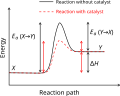 Activation energy diagram
 -
 Chemical kinetics

Ad. Transform your life with W8MD's
GLP-1 weight loss injections special from $29.99 with insurance
|
WikiMD Medical Encyclopedia |
Medical Disclaimer: WikiMD is for informational purposes only and is not a substitute for professional medical advice. Content may be inaccurate or outdated and should not be used for diagnosis or treatment. Always consult your healthcare provider for medical decisions. Verify information with trusted sources such as CDC.gov and NIH.gov. By using this site, you agree that WikiMD is not liable for any outcomes related to its content. See full disclaimer.
Credits:Most images are courtesy of Wikimedia commons, and templates, categories Wikipedia, licensed under CC BY SA or similar.
Translate this page: - East Asian
中文,
日本,
한국어,
South Asian
हिन्दी,
தமிழ்,
తెలుగు,
Urdu,
ಕನ್ನಡ,
Southeast Asian
Indonesian,
Vietnamese,
Thai,
မြန်မာဘာသာ,
বাংলা
European
español,
Deutsch,
français,
Greek,
português do Brasil,
polski,
română,
русский,
Nederlands,
norsk,
svenska,
suomi,
Italian
Middle Eastern & African
عربى,
Turkish,
Persian,
Hebrew,
Afrikaans,
isiZulu,
Kiswahili,
Other
Bulgarian,
Hungarian,
Czech,
Swedish,
മലയാളം,
मराठी,
ਪੰਜਾਬੀ,
ગુજરાતી,
Portuguese,
Ukrainian
