Endomorphin
Endomorphin refers to two opioid peptides, named endomorphin-1 and endomorphin-2. These peptides are known for their high affinity and specificity for the μ-opioid receptor. Endomorphins are considered to be natural endogenous ligands for the μ-opioid receptor, which is a critical receptor in the modulation of pain and analgesia in the human body. The discovery of endomorphins has contributed significantly to the understanding of pain management and the development of pain-relieving drugs.
Discovery[edit]
Endomorphins were discovered in the late 1990s through the efforts of researchers looking for natural ligands of the μ-opioid receptor. Their discovery was significant because it provided insight into the body's natural mechanisms for modulating pain and offered potential pathways for developing new analgesic drugs.
Structure[edit]
Endomorphin-1 and endomorphin-2 are tetrapeptides, meaning they are composed of four amino acids. The sequence for endomorphin-1 is Tyr-Pro-Trp-Phe, and for endomorphin-2, it is Tyr-Pro-Phe-Phe. This small size and specific amino acid sequence contribute to their high affinity and specificity for the μ-opioid receptor.
Function[edit]
The primary function of endomorphins is to bind to the μ-opioid receptor, leading to analgesia or pain relief. They are part of the body's endogenous opioid system, which is involved in a variety of physiological processes, including pain modulation, stress response, and immune response. Endomorphins play a crucial role in this system by modulating pain and reducing the perception of pain in the central nervous system.
Clinical Significance[edit]
The high specificity of endomorphins for the μ-opioid receptor makes them of particular interest for the development of new analgesic drugs. Unlike synthetic opioids, which can have a wide range of side effects and a high potential for addiction and abuse, endomorphins offer the possibility of developing pain relief medications with fewer side effects and lower risks of addiction.
Research and Development[edit]
Research into endomorphins is ongoing, with studies focusing on understanding their role in pain modulation, their potential therapeutic applications, and the development of synthetic analogs that can mimic their action. The goal is to develop drugs that can provide effective pain relief without the drawbacks associated with current opioid medications.
Conclusion[edit]
Endomorphins represent a significant area of interest in the field of pain management and drug development. Their discovery has opened new avenues for understanding how the body modulates pain and for developing new, more effective, and safer analgesic drugs.

-
 Endomorphin 1 structure
 -
 Endomorphin 2 structure
 -
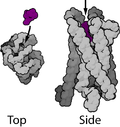 Mu-opioid receptor (GPCR)


.png)
Medical Disclaimer: WikiMD is for informational purposes only and is not a substitute for professional medical advice. Content may be inaccurate or outdated and should not be used for diagnosis or treatment. Always consult your healthcare provider for medical decisions. Verify information with trusted sources such as CDC.gov and NIH.gov. By using this site, you agree that WikiMD is not liable for any outcomes related to its content. See full disclaimer.
Credits:Most images are courtesy of Wikimedia commons, and templates, categories Wikipedia, licensed under CC BY SA or similar.
Translate this page: - East Asian
中文,
日本,
한국어,
South Asian
हिन्दी,
தமிழ்,
తెలుగు,
Urdu,
ಕನ್ನಡ,
Southeast Asian
Indonesian,
Vietnamese,
Thai,
မြန်မာဘာသာ,
বাংলা
European
español,
Deutsch,
français,
Greek,
português do Brasil,
polski,
română,
русский,
Nederlands,
norsk,
svenska,
suomi,
Italian
Middle Eastern & African
عربى,
Turkish,
Persian,
Hebrew,
Afrikaans,
isiZulu,
Kiswahili,
Other
Bulgarian,
Hungarian,
Czech,
Swedish,
മലയാളം,
मराठी,
ਪੰਜਾਬੀ,
ગુજરાતી,
Portuguese,
Ukrainian
