1,2-rearrangement
Chemical reaction involving the migration of a substituent from one atom to an adjacent atom
1,2-Rearrangement is a type of rearrangement reaction in which a substituent moves from one atom to an adjacent atom within a molecule. This process is a fundamental transformation in organic chemistry and can lead to significant changes in the structure and properties of the molecule.
Mechanism[edit]
In a 1,2-rearrangement, the migration of a substituent occurs between two adjacent atoms, typically involving a carbon atom. The rearrangement can proceed through a variety of mechanisms, including radical, cationic, and anionic pathways. The driving force for the rearrangement is often the formation of a more stable intermediate or product.
Radical Mechanism[edit]
In a radical mechanism, the rearrangement involves the movement of a substituent via a free radical intermediate. This type of rearrangement is often initiated by the homolytic cleavage of a bond, leading to the formation of radicals that can undergo migration.
Cationic Mechanism[edit]
Cationic 1,2-rearrangements involve the migration of a substituent in the presence of a carbocation intermediate. These rearrangements are common in reactions such as the Wagner-Meerwein rearrangement, where the migration leads to a more stable carbocation.
Anionic Mechanism[edit]
Anionic rearrangements involve the migration of a substituent in the presence of a negatively charged intermediate. These rearrangements are less common but can occur under specific conditions where an anion is stabilized by the surrounding molecular environment.
Examples[edit]
Wieland Radical Rearrangement[edit]
The Wieland radical rearrangement is a classic example of a radical 1,2-rearrangement. In this reaction, a radical species undergoes a 1,2-shift, resulting in the migration of a substituent to an adjacent position.
Aryl 1,2-Shift[edit]
An aryl 1,2-shift involves the migration of an aryl group from one position to an adjacent position within a molecule. This type of rearrangement can occur under specific conditions and is often facilitated by the presence of a suitable leaving group or catalyst.
Applications[edit]
1,2-Rearrangements are utilized in the synthesis of complex organic molecules. They are valuable tools in synthetic chemistry for constructing new carbon-carbon bonds and for the functionalization of molecules. These rearrangements are also important in the biosynthesis of natural products and in the development of pharmaceuticals.
Related pages[edit]
Gallery[edit]
-
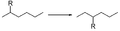 General scheme of a 1,2-rearrangement
 -
 Wieland radical rearrangement
 -
 Aryl 1,2-shift


1,2-rearrangement[edit]
-
1,2-rearrangement
-
Wieland Radical Rearrangement
-
Aryl 1,2-shift
Ad. Transform your health with W8MD Weight Loss, Sleep & MedSpa

Tired of being overweight?
Get started with evidence based, physician-supervised
affordable GLP-1 weight loss injections
Now available in New York City and Philadelphia:
- Semaglutide starting from $59.99/week and up
- Tirzepatide starting from $69.99/week and up (dose dependent)
✔ Evidence-based medical weight loss ✔ Insurance-friendly visits available ✔ Same-week appointments, evenings & weekends
Learn more:
Start your transformation today with W8MD weight loss centers.
|
WikiMD Medical Encyclopedia |
Medical Disclaimer: WikiMD is for informational purposes only and is not a substitute for professional medical advice. Content may be inaccurate or outdated and should not be used for diagnosis or treatment. Always consult your healthcare provider for medical decisions. Verify information with trusted sources such as CDC.gov and NIH.gov. By using this site, you agree that WikiMD is not liable for any outcomes related to its content. See full disclaimer.
Credits:Most images are courtesy of Wikimedia commons, and templates, categories Wikipedia, licensed under CC BY SA or similar.
Translate this page: - East Asian
中文,
日本,
한국어,
South Asian
हिन्दी,
தமிழ்,
తెలుగు,
Urdu,
ಕನ್ನಡ,
Southeast Asian
Indonesian,
Vietnamese,
Thai,
မြန်မာဘာသာ,
বাংলা
European
español,
Deutsch,
français,
Greek,
português do Brasil,
polski,
română,
русский,
Nederlands,
norsk,
svenska,
suomi,
Italian
Middle Eastern & African
عربى,
Turkish,
Persian,
Hebrew,
Afrikaans,
isiZulu,
Kiswahili,
Other
Bulgarian,
Hungarian,
Czech,
Swedish,
മലയാളം,
मराठी,
ਪੰਜਾਬੀ,
ગુજરાતી,
Portuguese,
Ukrainian
