Photoperiodism
Photoperiodism is a biological response of organisms to the length of day or night. It is a critical factor in the control of seasonal activities in both plants and animals. The concept of photoperiodism was first described by Garnett Thomas Morgan in 1920.
Overview[edit]
Photoperiodism is the physiological reaction of organisms to the length of day or night. It is vital in determining the seasonal activities of plants and animals. Photoperiodism does not depend on the intensity of light but on the duration of light and dark periods within a 24-hour cycle.
Mechanism[edit]
The mechanism of photoperiodism involves the perception of day length by a photoreceptor molecule, which then triggers a signal transduction pathway leading to a physiological response. In plants, the photoreceptor is a blue-light receptor called cryptochrome. In animals, the photoreceptor is typically located in the pineal gland.
In Plants[edit]
In plants, photoperiodism regulates flowering time, leaf fall, and the onset of winter dormancy. Plants are classified into three types based on their response to photoperiod: short-day plants, long-day plants, and day-neutral plants.
In Animals[edit]
In animals, photoperiodism influences the timing of reproduction, migration, and winter preparation. Animals use changes in day length as a calendar to anticipate changes in the environment associated with different seasons.
See Also[edit]

-
 Photoperiodism in plants
 -
 Long day plants
 -
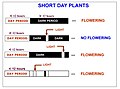 Short day plants


Ad. Transform your health with W8MD Weight Loss, Sleep & MedSpa

Tired of being overweight?
Special offer:
Budget GLP-1 weight loss medications
- Semaglutide starting from $29.99/week and up with insurance for visit of $59.99 and up per week self pay.
- Tirzepatide starting from $45.00/week and up (dose dependent) or $69.99/week and up self pay
✔ Same-week appointments, evenings & weekends
Learn more:
- GLP-1 weight loss clinic NYC
- W8MD's NYC medical weight loss
- W8MD Philadelphia GLP-1 shots
- Philadelphia GLP-1 injections
- Affordable GLP-1 shots NYC
|
WikiMD Medical Encyclopedia |
Medical Disclaimer: WikiMD is for informational purposes only and is not a substitute for professional medical advice. Content may be inaccurate or outdated and should not be used for diagnosis or treatment. Always consult your healthcare provider for medical decisions. Verify information with trusted sources such as CDC.gov and NIH.gov. By using this site, you agree that WikiMD is not liable for any outcomes related to its content. See full disclaimer.
Credits:Most images are courtesy of Wikimedia commons, and templates, categories Wikipedia, licensed under CC BY SA or similar.
Translate this page: - East Asian
中文,
日本,
한국어,
South Asian
हिन्दी,
தமிழ்,
తెలుగు,
Urdu,
ಕನ್ನಡ,
Southeast Asian
Indonesian,
Vietnamese,
Thai,
မြန်မာဘာသာ,
বাংলা
European
español,
Deutsch,
français,
Greek,
português do Brasil,
polski,
română,
русский,
Nederlands,
norsk,
svenska,
suomi,
Italian
Middle Eastern & African
عربى,
Turkish,
Persian,
Hebrew,
Afrikaans,
isiZulu,
Kiswahili,
Other
Bulgarian,
Hungarian,
Czech,
Swedish,
മലയാളം,
मराठी,
ਪੰਜਾਬੀ,
ગુજરાતી,
Portuguese,
Ukrainian
