Product (chemistry)
Product (chemistry)
In chemistry, a product is a substance that is formed as the result of a chemical reaction. In a reaction, starting materials called reactants interact with each other. After passing through a high energy transition state (this can be thought of as the top of a hill that must be climbed), the chemical reaction gives out the products.
Formation of Products[edit]
The formation of products in a chemical reaction is influenced by several factors, including the chemical species, the temperature, the pressure, and the presence of catalysts. The rate at which products are formed in a chemical reaction is described by the rate equation.
Types of Products[edit]
Products can be categorized into several types based on the type of chemical reaction from which they are formed:
- Combustion Products: These are products formed from a combustion reaction. Common examples include carbon dioxide and water.
- Redox Products: These are products formed from a redox (reduction-oxidation) reaction. An example is the formation of iron(III) oxide from iron and oxygen.
- Acid-Base Products: These are products formed from an acid-base reaction. An example is the formation of salt and water from an acid and a base.
- Precipitation Products: These are products formed from a precipitation reaction. An example is the formation of a solid precipitate from two aqueous solutions.
See Also[edit]
References[edit]
<references />

-
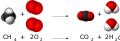 Diagram of methane combustion reaction
 -
 Illustration of lactose hydrolysis process
 -
 Image showing psoriasis on a fingernail


Ad. Transform your life with W8MD's
GLP-1 weight loss injections special from $29.99 with insurance
|
WikiMD Medical Encyclopedia |
Medical Disclaimer: WikiMD is for informational purposes only and is not a substitute for professional medical advice. Content may be inaccurate or outdated and should not be used for diagnosis or treatment. Always consult your healthcare provider for medical decisions. Verify information with trusted sources such as CDC.gov and NIH.gov. By using this site, you agree that WikiMD is not liable for any outcomes related to its content. See full disclaimer.
Credits:Most images are courtesy of Wikimedia commons, and templates, categories Wikipedia, licensed under CC BY SA or similar.
Translate this page: - East Asian
中文,
日本,
한국어,
South Asian
हिन्दी,
தமிழ்,
తెలుగు,
Urdu,
ಕನ್ನಡ,
Southeast Asian
Indonesian,
Vietnamese,
Thai,
မြန်မာဘာသာ,
বাংলা
European
español,
Deutsch,
français,
Greek,
português do Brasil,
polski,
română,
русский,
Nederlands,
norsk,
svenska,
suomi,
Italian
Middle Eastern & African
عربى,
Turkish,
Persian,
Hebrew,
Afrikaans,
isiZulu,
Kiswahili,
Other
Bulgarian,
Hungarian,
Czech,
Swedish,
മലയാളം,
मराठी,
ਪੰਜਾਬੀ,
ગુજરાતી,
Portuguese,
Ukrainian
