Agave syrup
Agave Syrup[edit]

Agave syrup, also known as agave nectar, is a sweetener commercially produced from several species of agave, including Agave tequilana (blue agave) and Agave salmiana. Agave syrup is sweeter than honey and tends to be less viscous.
Production[edit]
Agave syrup is produced from the juice of the agave plant. The process involves extracting the juice from the core of the plant, known as the "piña." The juice is then filtered and heated to break down the complex components into simple sugars. The resulting liquid is concentrated to form a syrup.
Composition[edit]
Agave syrup is primarily composed of fructose and glucose. The high fructose content gives it a low glycemic index, which means it has a minimal impact on blood sugar levels compared to other sweeteners like sucrose.
Uses[edit]
Agave syrup is used as a sweetener in a variety of food and beverage products. It is popular in vegan cooking as a substitute for honey. It is also used in baking, beverages, and as a topping for pancakes and waffles.
Health Considerations[edit]
While agave syrup is marketed as a natural sweetener, its high fructose content has raised concerns about its health effects. Excessive consumption of fructose can lead to metabolic disorders, including insulin resistance and fatty liver disease.
Related Pages[edit]
-
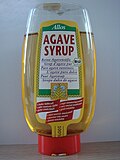 Agave Syrup
 -
 Agave tequilana

Ad. Transform your health with W8MD Weight Loss, Sleep & MedSpa

Tired of being overweight?
Special offer:
Budget GLP-1 weight loss medications
- Semaglutide starting from $29.99/week and up with insurance for visit of $59.99 and up per week self pay.
- Tirzepatide starting from $45.00/week and up (dose dependent) or $69.99/week and up self pay
✔ Same-week appointments, evenings & weekends
Learn more:
- GLP-1 weight loss clinic NYC
- W8MD's NYC medical weight loss
- W8MD Philadelphia GLP-1 shots
- Philadelphia GLP-1 injections
- Affordable GLP-1 shots NYC
|
WikiMD Medical Encyclopedia |
Medical Disclaimer: WikiMD is for informational purposes only and is not a substitute for professional medical advice. Content may be inaccurate or outdated and should not be used for diagnosis or treatment. Always consult your healthcare provider for medical decisions. Verify information with trusted sources such as CDC.gov and NIH.gov. By using this site, you agree that WikiMD is not liable for any outcomes related to its content. See full disclaimer.
Credits:Most images are courtesy of Wikimedia commons, and templates, categories Wikipedia, licensed under CC BY SA or similar.
Translate this page: - East Asian
中文,
日本,
한국어,
South Asian
हिन्दी,
தமிழ்,
తెలుగు,
Urdu,
ಕನ್ನಡ,
Southeast Asian
Indonesian,
Vietnamese,
Thai,
မြန်မာဘာသာ,
বাংলা
European
español,
Deutsch,
français,
Greek,
português do Brasil,
polski,
română,
русский,
Nederlands,
norsk,
svenska,
suomi,
Italian
Middle Eastern & African
عربى,
Turkish,
Persian,
Hebrew,
Afrikaans,
isiZulu,
Kiswahili,
Other
Bulgarian,
Hungarian,
Czech,
Swedish,
മലയാളം,
मराठी,
ਪੰਜਾਬੀ,
ગુજરાતી,
Portuguese,
Ukrainian
