Gadolinium(III) nitrate
Gadolinium(III) nitrate is a chemical compound with the formula Gd(NO3)3. It is one of the nitrate salts of gadolinium, a rare earth metal with atomic number 64. Gadolinium(III) nitrate is used in various applications, including as a component in certain types of nuclear reactors, in laboratory research, and in the production of phosphors for color television tubes and fluorescent lamps. This compound is also of interest in the field of magnetic resonance imaging (MRI) as a potential contrast agent, due to the paramagnetic properties of gadolinium.
Properties[edit]
Gadolinium(III) nitrate is a colorless, water-soluble solid. It is highly hygroscopic, meaning it readily absorbs water from the atmosphere. The compound forms several hydrates, the most common of which is the hexahydrate, Gd(NO3)3·6H2O. When dissolved in water, gadolinium(III) nitrate dissociates into gadolinium ions (Gd3+) and nitrate ions (NO3−), which can interact with other ions and molecules in solution.
Synthesis[edit]
Gadolinium(III) nitrate can be synthesized by reacting gadolinium metal, its oxide, or carbonate with nitric acid. The reaction typically yields gadolinium(III) nitrate in aqueous solution, which can then be crystallized, often as a hydrate.
Applications[edit]
Nuclear Reactors[edit]
In nuclear technology, gadolinium(III) nitrate is used as a neutron absorber due to the high neutron cross-section of gadolinium. This property makes it valuable in controlling the reactivity of nuclear reactors and in emergency shutdown systems.
Research and Industry[edit]
In the laboratory, gadolinium(III) nitrate is used in various chemical syntheses and material science experiments, particularly those involving rare earth elements and their compounds. Its paramagnetic properties are exploited in the development of phosphors and in research into magnetic materials.
Medical Imaging[edit]
Gadolinium(III) nitrate is of interest in medical imaging as a potential contrast agent in magnetic resonance imaging (MRI). Gadolinium compounds enhance the contrast of images by altering the relaxation times of protons in water molecules within the body, improving the visibility of internal structures.
Safety[edit]
Handling gadolinium(III) nitrate requires caution. Like other nitrates, it is an oxidizing agent and should be kept away from flammable materials. Gadolinium compounds can be toxic, particularly in soluble forms, and should be handled with appropriate safety measures to avoid ingestion, inhalation, or skin contact.
Environmental Impact[edit]
The environmental impact of gadolinium(III) nitrate is a subject of ongoing research. Gadolinium, being a rare earth element, can accumulate in the environment and has been detected in natural waters, raising concerns about its potential effects on ecosystems and human health.

-
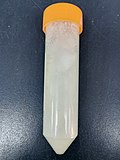 Gadolinium(III) nitrate hexahydrate
_nitrate_hexahydrate.jpg)
Ad. Transform your health with W8MD Weight Loss, Sleep & MedSpa

Tired of being overweight?
Get started with evidence based, physician-supervised
affordable GLP-1 weight loss injections
Now available in New York City and Philadelphia:
- Semaglutide starting from $59.99/week and up
- Tirzepatide starting from $69.99/week and up (dose dependent)
✔ Evidence-based medical weight loss ✔ Insurance-friendly visits available ✔ Same-week appointments, evenings & weekends
Learn more:
Start your transformation today with W8MD weight loss centers.
|
WikiMD Medical Encyclopedia |
Medical Disclaimer: WikiMD is for informational purposes only and is not a substitute for professional medical advice. Content may be inaccurate or outdated and should not be used for diagnosis or treatment. Always consult your healthcare provider for medical decisions. Verify information with trusted sources such as CDC.gov and NIH.gov. By using this site, you agree that WikiMD is not liable for any outcomes related to its content. See full disclaimer.
Credits:Most images are courtesy of Wikimedia commons, and templates, categories Wikipedia, licensed under CC BY SA or similar.
Translate this page: - East Asian
中文,
日本,
한국어,
South Asian
हिन्दी,
தமிழ்,
తెలుగు,
Urdu,
ಕನ್ನಡ,
Southeast Asian
Indonesian,
Vietnamese,
Thai,
မြန်မာဘာသာ,
বাংলা
European
español,
Deutsch,
français,
Greek,
português do Brasil,
polski,
română,
русский,
Nederlands,
norsk,
svenska,
suomi,
Italian
Middle Eastern & African
عربى,
Turkish,
Persian,
Hebrew,
Afrikaans,
isiZulu,
Kiswahili,
Other
Bulgarian,
Hungarian,
Czech,
Swedish,
മലയാളം,
मराठी,
ਪੰਜਾਬੀ,
ગુજરાતી,
Portuguese,
Ukrainian
