Chernoff face
Chernoff faces are a method of multivariate data visualization using facial features to represent different dimensions of data. This technique was introduced by Herman Chernoff in 1973, aiming to improve the interpretation of multivariate data. By mapping multiple data points to various facial characteristics, such as the shape of the face, the size and position of the eyes, nose, and mouth, Chernoff faces can display complex data sets in a more comprehensible and visually engaging manner. This method leverages human ability to recognize faces and subtle facial traits to interpret complex information more effectively than traditional data visualization techniques.
Overview[edit]
Chernoff faces represent each variable in the data set by a different facial feature. For example, the length of the face may represent one variable, while the curvature of the mouth may represent another. The values of these variables are scaled to the possible values for each facial feature. This allows for the visualization of multidimensional data in a two-dimensional, facial representation. The primary advantage of using Chernoff faces is their ability to display several variables at once, making it easier to identify patterns or anomalies within the data.
Application[edit]
Chernoff faces have been applied in various fields, including statistics, data analysis, psychology, and more recently, in machine learning and data mining. They are particularly useful in exploratory data analysis, where the goal is to uncover underlying patterns or relationships within the data. However, the interpretability of Chernoff faces can be subjective, as the ability to recognize and interpret facial expressions varies from person to person.
Limitations[edit]
While Chernoff faces are a powerful tool for data visualization, they have limitations. The main challenge is the subjective nature of facial recognition. What one person perceives as a significant difference in facial expression, another might not notice. This subjectivity can lead to misinterpretation of the data. Additionally, when too many variables are represented, the faces can become cluttered and difficult to interpret. Therefore, Chernoff faces are most effective when used to visualize datasets with a moderate number of variables.
Creating Chernoff Faces[edit]
To create Chernoff faces, one must first normalize the data to ensure that each variable contributes equally to the facial features. After normalization, each variable is assigned to a specific facial feature. The values of these variables are then mapped to the corresponding facial characteristics, creating a unique face for each data point. Various software packages and programming languages, including R and Python, offer libraries and functions to generate Chernoff faces.
See Also[edit]
References[edit]
<references/>
This data visualization related article is a stub. You can help WikiMD by expanding it.
-
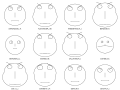 Chernoff faces for evaluations of US judges

Ad. Transform your health with W8MD Weight Loss, Sleep & MedSpa

Tired of being overweight?
Special offer:
Budget GLP-1 weight loss medications
- Semaglutide starting from $29.99/week and up with insurance for visit of $59.99 and up per week self pay.
- Tirzepatide starting from $45.00/week and up (dose dependent) or $69.99/week and up self pay
✔ Same-week appointments, evenings & weekends
Learn more:
- GLP-1 weight loss clinic NYC
- W8MD's NYC medical weight loss
- W8MD Philadelphia GLP-1 shots
- Philadelphia GLP-1 injections
- Affordable GLP-1 shots NYC
|
WikiMD Medical Encyclopedia |
Medical Disclaimer: WikiMD is for informational purposes only and is not a substitute for professional medical advice. Content may be inaccurate or outdated and should not be used for diagnosis or treatment. Always consult your healthcare provider for medical decisions. Verify information with trusted sources such as CDC.gov and NIH.gov. By using this site, you agree that WikiMD is not liable for any outcomes related to its content. See full disclaimer.
Credits:Most images are courtesy of Wikimedia commons, and templates, categories Wikipedia, licensed under CC BY SA or similar.
Translate this page: - East Asian
中文,
日本,
한국어,
South Asian
हिन्दी,
தமிழ்,
తెలుగు,
Urdu,
ಕನ್ನಡ,
Southeast Asian
Indonesian,
Vietnamese,
Thai,
မြန်မာဘာသာ,
বাংলা
European
español,
Deutsch,
français,
Greek,
português do Brasil,
polski,
română,
русский,
Nederlands,
norsk,
svenska,
suomi,
Italian
Middle Eastern & African
عربى,
Turkish,
Persian,
Hebrew,
Afrikaans,
isiZulu,
Kiswahili,
Other
Bulgarian,
Hungarian,
Czech,
Swedish,
മലയാളം,
मराठी,
ਪੰਜਾਬੀ,
ગુજરાતી,
Portuguese,
Ukrainian
