Agrimonia eupatoria
Agrimonia eupatoria

Agrimonia eupatoria, commonly known as agrimony, is a perennial herbaceous plant of the family Rosaceae. It is native to temperate regions of the Northern Hemisphere, including Europe, Asia, and North America.
Description
Agrimonia eupatoria is a hardy perennial that grows to a height of 30 to 60 cm. The plant has a slender, hairy stem and bears pinnate leaves with serrated edges. The leaves are dark green on the upper side and lighter underneath. The plant produces small, yellow flowers arranged in long, slender spikes. These flowers bloom from June to September.
The fruit of Agrimonia eupatoria is a small, burr-like achene that clings to animal fur and clothing, aiding in seed dispersal.
Habitat
Agrimonia eupatoria thrives in a variety of habitats, including grasslands, roadsides, and open woodlands. It prefers well-drained soils and can often be found in areas with full sun to partial shade.
Uses
Historically, Agrimonia eupatoria has been used in traditional medicine for its purported health benefits. It has been employed as a remedy for digestive disorders, sore throats, and skin conditions. The plant contains tannins, which contribute to its astringent properties.
In addition to its medicinal uses, agrimony has been used as a dye plant, producing a yellow dye from its flowers and leaves.
Cultivation
Agrimonia eupatoria is relatively easy to cultivate. It can be propagated by seed or division. The plant prefers a sunny location with well-drained soil. Once established, it requires minimal maintenance and is drought-tolerant.
Related pages
Gallery
-
 Agrimonia eupatoria in Keila
 -
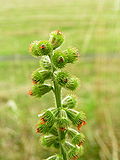 Close-up of Agrimonia eupatoria flowers
 -
 Specimen of Agrimonia eupatoria
 -
 Historical illustration of Agrimonia eupatoria


_-_Theodore_Green_-_26_1931_8.jpg)
Ad. Transform your life with W8MD's
GLP-1 weight loss injections special from $29.99 with insurance
|
WikiMD Medical Encyclopedia |
Medical Disclaimer: WikiMD is for informational purposes only and is not a substitute for professional medical advice. Content may be inaccurate or outdated and should not be used for diagnosis or treatment. Always consult your healthcare provider for medical decisions. Verify information with trusted sources such as CDC.gov and NIH.gov. By using this site, you agree that WikiMD is not liable for any outcomes related to its content. See full disclaimer.
Credits:Most images are courtesy of Wikimedia commons, and templates, categories Wikipedia, licensed under CC BY SA or similar.
Translate this page: - East Asian
中文,
日本,
한국어,
South Asian
हिन्दी,
தமிழ்,
తెలుగు,
Urdu,
ಕನ್ನಡ,
Southeast Asian
Indonesian,
Vietnamese,
Thai,
မြန်မာဘာသာ,
বাংলা
European
español,
Deutsch,
français,
Greek,
português do Brasil,
polski,
română,
русский,
Nederlands,
norsk,
svenska,
suomi,
Italian
Middle Eastern & African
عربى,
Turkish,
Persian,
Hebrew,
Afrikaans,
isiZulu,
Kiswahili,
Other
Bulgarian,
Hungarian,
Czech,
Swedish,
മലയാളം,
मराठी,
ਪੰਜਾਬੀ,
ગુજરાતી,
Portuguese,
Ukrainian
