Adenylate kinase
Adenylate Kinase

Adenylate kinase is an important enzyme in cellular energy metabolism. It catalyzes the interconversion of adenine nucleotides, which is crucial for maintaining the energy balance within the cell. The enzyme is found in various cellular compartments and is highly conserved across different species.
Function
Adenylate kinase plays a key role in the phosphotransfer network of the cell. It catalyzes the reversible transfer of a phosphate group from adenosine triphosphate (ATP) to adenosine monophosphate (AMP), producing two molecules of adenosine diphosphate (ADP):
- ATP + AMP _ 2 ADP
This reaction is essential for the maintenance of cellular energy homeostasis, especially under conditions where the demand for ATP is high.
Structure
The structure of adenylate kinase consists of several domains that facilitate its function. The enzyme typically has a nucleotide-binding domain, a lid domain, and a core domain. These domains undergo conformational changes during the catalytic cycle, which are essential for its activity.

Mechanism
The catalytic mechanism of adenylate kinase involves the binding of substrates to the active site, followed by a series of conformational changes that facilitate the transfer of the phosphate group. The enzyme stabilizes the transition state and lowers the activation energy of the reaction.
Kinetics
The kinetic cycle of adenylate kinase involves several steps, including substrate binding, catalysis, and product release. The enzyme exhibits Michaelis-Menten kinetics, and its activity can be regulated by various factors, including substrate concentration and allosteric regulation.

Isoforms
There are multiple isoforms of adenylate kinase, each with specific roles and localizations within the cell. These isoforms are encoded by different genes and can be found in the cytosol, mitochondria, and other cellular compartments.
Clinical Significance
Mutations in adenylate kinase genes can lead to various metabolic disorders. The enzyme is also a target for drug development, as it plays a role in cancer metabolism and other diseases.
Related Pages
Gallery
-
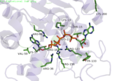 Structure of adenylate kinase
 -
 Binding of Ap5A in the active site
 -
 Kinetic cycle
Ad. Transform your life with W8MD's
GLP-1 weight loss injections special from $29.99 with insurance
|
WikiMD Medical Encyclopedia |
Medical Disclaimer: WikiMD is for informational purposes only and is not a substitute for professional medical advice. Content may be inaccurate or outdated and should not be used for diagnosis or treatment. Always consult your healthcare provider for medical decisions. Verify information with trusted sources such as CDC.gov and NIH.gov. By using this site, you agree that WikiMD is not liable for any outcomes related to its content. See full disclaimer.
Credits:Most images are courtesy of Wikimedia commons, and templates, categories Wikipedia, licensed under CC BY SA or similar.
Translate this page: - East Asian
中文,
日本,
한국어,
South Asian
हिन्दी,
தமிழ்,
తెలుగు,
Urdu,
ಕನ್ನಡ,
Southeast Asian
Indonesian,
Vietnamese,
Thai,
မြန်မာဘာသာ,
বাংলা
European
español,
Deutsch,
français,
Greek,
português do Brasil,
polski,
română,
русский,
Nederlands,
norsk,
svenska,
suomi,
Italian
Middle Eastern & African
عربى,
Turkish,
Persian,
Hebrew,
Afrikaans,
isiZulu,
Kiswahili,
Other
Bulgarian,
Hungarian,
Czech,
Swedish,
മലയാളം,
मराठी,
ਪੰਜਾਬੀ,
ગુજરાતી,
Portuguese,
Ukrainian
